Finding the right angle plate is essential for accurate milling, drilling, and workholding. The following selections focus on sturdy construction, precise tolerances, and versatile adjustment ranges to suit a variety of machines and workloads. Each product is evaluated for build quality, clamping options, and alignment features to help you choose with confidence.
Product Quick Overview
Below is a quick reference table for five high-performing angle plates and accessories commonly used with milling machines. Use this as a snapshot while you read more about each option.
| Product | Brand | Key Feature | Typical Use |
|---|---|---|---|
| BestEquip Tilting Milling Table 10×7 | BestEquip | 0-80° adjustable, 3 T-slots | Heavy-duty milling setups |
| BestEquip Tilting Milling Table 7×5 | BestEquip | 0-90° adjustable, clear dial | Grinding and precise positioning |
| 100 mm/4″ Stepped Angle Plate | AD INTERNATIONAL | Stepped cast iron, precise ground | Clamping at multiple angles |
| Assorts Precision Graded Caste Iron Vee Plate | ASSORTS | Stress-relieved, machined slots | Fixed-angle workholding |
| Preamer AP25 Adjustable Micro Angle Gauge | Preamer | 0-60° with locking screw | Fine angle setup |
Choosing the right angle plate depends on your workholding needs, the capacity of your milling setup, and the precision required for your projects. The following sections provide detailed product notes to help you compare features side by side.
BestEquip Tilting Milling Table 10×7 Inch

The BestEquip 10×7 inch tilting milling table combines robust cast-iron construction with practical versatility. Its heavy-duty design resists corrosion and wear in demanding workshop environments, supporting long service life. The table includes three 12 mm T-slots to securely position workpieces and accessories, providing ample space for tooling during complex milling operations. The adjustable angle range spans from 0 to 80 degrees on both sides, with a clear dial to improve measurement precision. A manual crank handle enables quick, repeatable angle changes, making it well-suited for facing, slotting, and inclined plane milling tasks. This model emphasizes stability and repeatability, which are crucial for high-precision setups.
Key considerations:
- Pros: High rigidity, wide angle range, clear angle indication, multiple T-slots for flexible tool placement.
- Cons: Heavier than smaller plates; requires sturdy mounting base for best performance.
BestEquip Tilting Milling Table 7×5 Inch
This smaller 7×5 inch tilting angle plate mirrors the sturdy construction of its larger sibling, offering a 0-90 degree adjustable range with a precise dial for angle measurement. It features three T-slots for flexible clamping and positioning of tools, fixtures, and workpieces. The crank-style adjustment allows quick angle changes, making it ideal for precise milling or grinding tasks that require accurate angular setup in a compact footprint. Its compact size is beneficial for benchtop machines or setups with limited space, while still delivering reliable rigidity and repeatable results.
Key considerations:
- Pros: Compact, precise 0-90° adjustment, clear dial for repeatable angles.
- Cons: Slightly smaller work surface limits larger workpieces.
100 mm / 4″ Stepped Angle Plate

The AD INTERNATIONAL stepped angle plate provides a stepped cast-iron design with precise grounding and a robust webbed structure for high rigidity. It is particularly useful for clamping workpieces in multiple fixed angles where repeatable accuracy is required. The plate is designed to accommodate threaded holes, including a 5/16″ tapped size, which helps in attaching fixtures or aligning jigs. This model is well-suited for engineers needing consistent angle settings across multiple setups or for specialty milling operations where fixed reference angles are frequently used.
Key considerations:
- Pros: Solid rigidity, stepped angles for repeatable setups, compatible with standard drilling and milling fixtures.
- Cons: Limited to fixed positions unless complemented by other adjustable components.
Assorts Precision Graded Caste Iron Vee Plate

The Assorts precision graded vee angle plate is engineered from stress-relieved cast iron with machined slots, delivering reliable concentricity and edge quality. The product line includes various sizes, with this 3″ x 3″ x 5″ model offering a compact workholding solution that integrates with T-slots or traditional clamps. The beveled edges and smooth finishes reduce marring on workpieces, while the stress-relieved material helps maintain dimensional stability under machining loads. This option is especially useful for round or curved components where a V-groove aligns and positions consistently.
Key considerations:
- Pros: High rigidity for small-to-medium parts, stress-relieved for stability, multiple size options available.
- Cons: May require additional fixtures for complex workpieces.
Preamer AP25 Adjustable Micro Angle Gauge
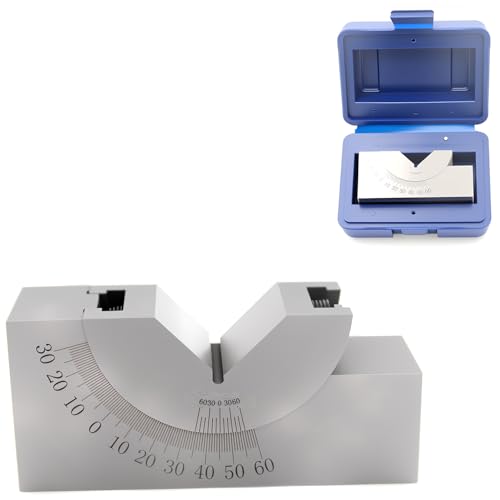
The Preamer AP25 offers a compact 0-60 degree adjustable micro angle gauge for milling, lathe, and drill press applications. Its simple operation and locking mechanism enable quick setup changes with high repeatability. The device is designed for ease of use, allowing machinists to lock angles precisely and transfer them to setups for drilling, milling, or groove cutting. The angled gauge is particularly useful for tasks requiring exact oblique cuts or bevels, and it supports straightforward integration into standard fixtures and jigs.
Key considerations:
- Pros: Easy operation, precise angle range, reliable locking mechanism.
- Cons: Limited to 0-60° range; may need additional accessories for larger angles.
Buying Guide: Angle Plates And How To Choose
When selecting an angle plate or related workholding accessory for milling, consider the following factors to ensure you get a setup that matches your workflow:
- Material and construction: Cast iron offers rigidity and damping, while stainless variants provide corrosion resistance. Heavier plates stay more stable but require robust mounting.
- Angle range and precision: Wider ranges and clear angle dials improve adaptability and repeatability. For frequent angle changes, crank handles and fine adjustment features help minimize setup time.
- Three-through T-slots: A common standard that accommodates a wide range of clamps, stops, and fixtures. Ensure slot spacing aligns with your tooling and vices.
- Surface finish and edge treatment: Machined, chamfered edges prevent marring and improve clamping surfaces, especially for delicate parts.
- Footprint and compatibility: Check the plate size against your milling table, fixture plates, and vises. Smaller plates excel on benchtop machines; larger plates benefit heavy-duty setups.
- Compatibility with existing accessories: If you already own tappable or threaded fixtures, confirm thread sizes and compatibility with the plate’s features.
- Use-case alignment: For fixed-angle operations, stepped angle plates provide repeatability. For dynamic setups, adjustable plates with precise dial indicators improve workflow efficiency.
In summary, your choice should balance rigidity, range of motion, and fixture compatibility. The BestEquip 10×7 and 7×5 models provide versatile adjustment ranges and solid lock-down, making them suitable for a wide range of milling tasks. The AD INTERNATIONAL stepped plate and Assorts Vee plate deliver strong performance for fixed-angle applications and small- to medium-sized parts. The Preamer AP25 adds a compact, precise option for micro-angle adjustments in tight spaces. Consider your typical part size, precision requirements, and available mounting space when deciding which setup best suits your shop.