Discover top-rated 50-plate heat exchangers designed for floor heating, water heating, snow melting, beer cooling, and industrial cooling. This guide highlights five reliable models featuring 316L stainless steel and copper brazing for durability and leak resistance, high heat transfer efficiency, and wide operating temperature ranges. Each product is sourced from Amazon, with clear specifications to help you compare performance and suitability for your system. Read on to learn how these exchangers can improve efficiency and reduce energy use in domestic and small commercial applications.
| Product | plates | Port Size | Material Highlight | Typical Uses |
|---|---|---|---|---|
| VEVOR EATB28-50 | 50 | 1″ MPT | 316L Stainless Steel / 99% Copper Brazing | Floor heating, water heating, snow melting, beer cooling |
| AB Plate Heat Exchanger 4″x12″ | 50 | 1″ MPT | 316L Stainless Steel / Copper Brazed | Floor heating, water heating, snow melting |
| AB Plate Heat Exchanger 3″x8″ | 50 | 3/4″ NPT | 316L Stainless Steel / Copper Brazed | Floor heating, water heating, snow melting |
| ALECOIL 5″x12″ | 50 | 1-1/4″ MPT | 316L Stainless Steel / Copper Brazing | Water heating, floor heating, refrigeration |
| AB Plate Heat Exchanger 5″x12″ | 50 | 1-1/4″ MPT | 316L Stainless Steel / Copper Brazed | Water heating, floor heating, snow melting |
VEVOR EATB28-50 50-Plate Heat Exchanger

Designed for high-pressure and high-temperature operation, this unit uses 316L stainless steel and 99% copper brazing at edges and contact points to form a robust, leak-resistant exchanger. UL and CE certifications indicate reliable quality. The high-conductivity plates feature an asymmetrical herringbone pattern, creating turbulence that enhances heat transfer. This layout supports up to 500-660K BTU per hour, aiding efficient heating and cooling while reducing pump load and energy use. With up to 50 plates and a 5″ x 12″ plate area, it accommodates demanding residential or light commercial applications.
Operating range spans from -292°F to 392°F, enabling use in a variety of heat exchange scenarios, including floor heating, water heating, snow melts, and even beverage cooling when integrated into appropriate systems. The combination of corrosion-resistant materials and a proven brazing method supports long service life in challenging environments, making it a versatile choice for modern installations.
AB Plate Heat Exchanger, 4″x12″ 50 Plates

This 50-plate model uses high-quality 316L stainless steel plates brazed with 99.9% copper at the edges to provide a rugged, leak-resistant core capable of withstanding high pressure and temperature. A smooth-thread design simplifies installation and field connections. The plates’ high conductivity and slim profile deliver efficient heat transfer without excessive energy use, suitable for both heating and cooling tasks. The unit is sized at 4″ x 12″ with 1″ MPT ports, delivering 400,000 to 450,000 BTU per hour depending on operating conditions.
AB Plate Heat Exchanger, 3″x8″ 50 Plates

This compact 50-plate exchanger uses 316L stainless steel plates brazed with copper at the edges to form a durable, leak-resistant unit. It emphasizes ease of use with a smooth-thread connection that supports quick, flexible hookups. The product provides 310,000 to 380,000 BTU per hour depending on application. With 50 plates across a 3″ x 8″ footprint and 3/4″ NPT ports, it’s well-suited for smaller spaces or zoned heating and cooling setups, delivering efficient heat transfer without excessive space requirements.
ALECOIL 5″x12″ 50 Plates Heat Exchanger

ALECOIL’s 5″x12″ exchanger uses 316L stainless steel plates brazed with copper in an oxygen-free environment to deliver high strength and corrosion resistance. Its asymmetric fish-bone plate design induces strong turbulence, improving heat transfer between media directions and reducing pressure drop on the secondary side. This enables using a smaller pump and lower electricity costs while providing up to 748,000 BTU/h capacity spread across 50 plates, with a 5″ x 12″ format and 1-1/4″ ports. The design supports demanding heating, cooling, and commercial refrigeration duties.
AB Plate Heat Exchanger, 5″x12″ 50 Plates
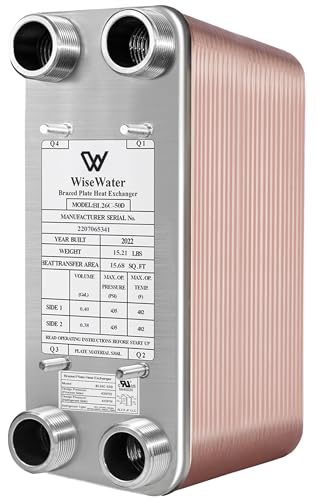
This 50-plate unit also uses high-quality 316L stainless steel plates brazed with copper along the edges to ensure a durable, leak-resistant assembly capable of withstanding high pressure and temperature. A smooth-thread design supports easy hookups, and the plate geometry promotes strong heat transfer with minimal energy usage. Rated for 500,000 to 680,000 BTU per hour, this model offers substantial heating and cooling capacity for larger residential systems or small commercial loops, with 50 plates across a 5″ x 12″ area and 1-1/4″ MPT ports.
Buying Guide: Key Purchase Considerations
When selecting a 50-plate heat exchanger, consider these factors to match your system needs and optimize performance:
- Plate size and count: A higher plate count increases surface area for heat transfer but also adds size and price. Ensure the footprint fits your install space and matches your heating or cooling load.
- Material integrity: Look for 316L stainless steel plates with copper brazing at edges to minimize leakage risk and support high temperature and pressure operations. Verify certifications if reliability is critical.
- Port size and connection type: Confirm port diameters (1″ MNPT, 1-1/4″ MPT, etc.) and thread compatibility with your piping. Smooth-thread options can simplify installation.
- Heat transfer efficiency: Plate geometry, such as asymmetrical herringbone or fish-bone designs, influences turbulence and overall efficiency. Higher efficiency reduces pump energy and operating costs.
- Operating temperature and pressure: Ensure the exchanger supports your working range, including extremes that may occur in floor heating or cooling cycles.
- Application suitability: Match the exchanger to your use case—floor heating, water heating, snow melting, or beer cooling—based on capacity and flow requirements.
- Maintenance and durability: Copper brazing improves leak resistance; however, consider ease of leak testing, cleaning, and corrosion resistance for your media.
- System integration: Plan for compatibility with existing pumps, valves, and controls. Consider future expansion to maintain efficiency across a larger system.
In choosing among these options, prioritize units with robust corrosion resistance, proven heat-transfer performance, and matching ports to your existing piping. For higher heating or cooling demands, models with 50 plates and larger BTU capacities offer greater headroom, while compact configurations excel in tight spaces.