Explore top 5 axis robot arm kits designed for learning coding, robotics, and automation. This guide highlights kits compatible with Raspberry Pi and Arduino ecosystems, offering programmable control, multiple motion axes, and open-source resources. Ideal for students, hobbyists, and makers seeking hands-on experience with robotics, AI-friendly tooling, and STEM education.
Summary of chosen products
| Product | Brand | Focus | Connectivity / Platform |
|---|---|---|---|
| Adeept 5-DOF Robotic Arm Kit (Black) | Adeept | 5-axis educational robot arm with Python tutorials | Raspberry Pi compatible; web interface and gamepad control |
| Adeept 5-DOF Robotic Arm Kit (Orange) | Adeept | 5-axis STEM learning with Python code | Raspberry Pi compatible; gamepad and web control |
| LewanSoul MiniArm Starter Kit | LewanSoul | Arduino-based 6-axis kit with open-source development | Arduino compatible; app/knob control; sensor expansion |
| LewanSoul MiniArm Standard Kit | LewanSoul | Open-source 6-axis arm with expansion options | Arduino compatible; enhanced sensor support |
| FREENOVE Robotic Arm Kit | FREENOVE | Raspberry Pi integration; clamping and drawing modes | Raspberry Pi compatible; Python code and tutorials |
Adeept 5-DOF Robotic Arm Kit Black

The Adeept 5-DOF robotic arm is designed to teach teens and beginners coding, building, and programming concepts. It is built around Raspberry Pi compatibility, supporting Raspberry Pi 4B/3B/3B+/3A+. Control methods include a gamepad driven by two Adeept PS2 joysticks and a web-based interface for remote operation. The kit emphasizes accessible Python code and tutorials to facilitate practical understanding of kinematics, control loops, and sensor feedback. This variant targets users seeking a robust entry into 5-axis robotics with hands-on programming exercises.
Key features include multi-modal control, straightforward assembly, and a focus on educational value. The combination of Pi-based control and a web GUI offers flexible experimentation environments. As an open-ended learning platform, users can explore real-time control, sequence programming, and sensor integration within a guided framework. This kit suits classrooms or home labs where students can iterate on motion planning and task automation tasks across common 5-axis configurations.
Adeept 5-DOF Robotic Arm Kit Orange
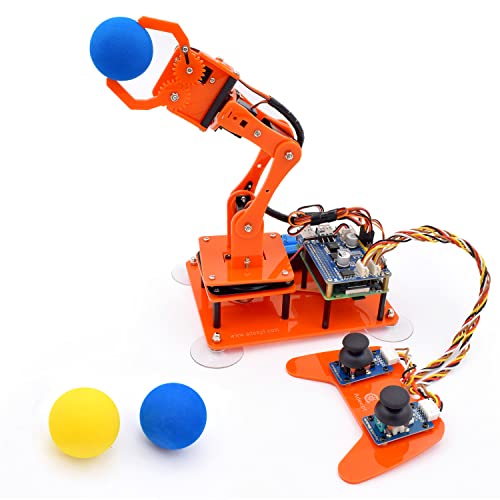
The orange variant mirrors the black version’s educational focus, delivering a 5-axis robotic arm kit designed for hands-on coding and engineering practice. It is also based on Raspberry Pi compatibility with support for Raspberry Pi 4B/3B+/3A+. The included Python code and tutorials reinforce practical software development workflows, while the dual joystick and web-based remote control cases illustrate diverse control paradigms. This kit is well-suited for learners seeking a visually distinct, similarly capable platform for robotics education and experimentation.
Educators and students can leverage the same software scaffolding used in the black variant to compare motion profiles, calibrate servos, and script task sequences. The combination of hardware and software resources supports experimentation with inverse kinematics concepts, motion planning, and repeatable automation tasks. The orange kit adds a color-coded option for projects or classroom demonstrations without sacrificing functionality.
LewanSoul MiniArm Starter Kit

The LewanSoul miniArm Starter Kit is an Arduino-based 6-axis robotic arm designed for open-source development. It emphasizes learning through hands-on programming, with tutorials and examples that support secondary development. The hardware includes a multi-port expansion system (including Bluetooth) and high-precision digital servos, enabling sensor integration and offline action editing. The starter kit positions itself as a gateway to robotics projects, making it suitable for classrooms, hobbyists, and makers who want a foundation for experimentation with sensor payloads, remote control, and custom actions.
Users can explore app control and real-time knob control, providing immediate, tactile feedback during experiments. The combination of hardware expandability and open-source software resources fosters a practical understanding of robotics, from basic servo control to more advanced actions like sorting or stacking with future upgrades. This kit is a practical choice for learners starting out with 6-axis robots and Arduino ecosystems.
LewanSoul MiniArm Standard Kit

The standard kit expands on the starter variant with additional capabilities and sensor support, still anchored in an Arduino-compatible, open-source framework. It continues to emphasize ease of learning and rapid prototyping through its 6-axis design and expansion ports. The kit’s emphasis on open-source tutorials and secondary development examples helps learners grow beyond basic servo control toward more complex tasks, such as sensor-based automation and data-driven experiments. This kit is well-suited for ongoing education, hobbyist projects, and modular robotics explorations.
FREENOVE Robot Arm Kit for Raspberry Pi

The FREENOVE Robotic Arm Kit is designed to integrate with Raspberry Pi, featuring clamping and drawing modes, along with record and replay capabilities. This kit emphasizes a hands-on approach to learning Python programming and robot control. It supports Raspberry Pi 5/4B/3B+/3B/3A+ and offers a structured learning path through step-by-step assembly instructions and Python code downloads. While Raspberry Pi is a core platform for this kit, some model-specific components may require additional parts for full compatibility with newer Pi boards. The kit is ideal for students who want a robust Pi-driven robotic arm with graphical modes for creative projects.
Buying Guide: Key Considerations for 5-Axis Robot Arm Kits
When selecting a 5-axis robot arm kit, consider these dimensions to tailor the choice to your needs:
- Platform compatibility: Decide whether you prefer Raspberry Pi, Arduino, or a web-based control interface. Ensure the kit’s software stack aligns with your hardware environment and language preferences (Python, C/C++, etc.).
- Control methods: Evaluate whether you want joystick/gamepad control, app-based control, or remote operation through a web interface. Multi-modal control supports experimentation with different programming paradigms and user experiences.
- Educational value and documentation: Look for clear tutorials, example projects, and open-source resources. Well-documented kits accelerate learning and enable students to explore advanced topics like kinematics, inverse kinematics, and vision integration.
- Expansion and sensing: Kits with additional ports, sensor support, or Bluetooth/ESP32 compatibility enable secondary development, data collection, and sensor-driven tasks. Consider future-proofing with modules you’re likely to use later.
- Build quality and materials: Aluminum frames and robust servos generally provide better stability and durability, especially for education and demonstrations. Assess base stability, payload capacity, and servo torque.
- Community and support: A vibrant user community and active developer forums help with troubleshooting, custom tutorials, and project ideas, making ongoing learning easier.
- Cost-to-value balance: While price varies, prioritize kits with strong instructional content and reliable hardware. A well-supported kit often yields a better long-term learning return than a cheaper, less-documented option.
In practice, the ideal kit for a classroom or home lab blends accessible programming with practical hardware. Raspberry Pi-based options encourage Python-based projects and OpenCV-centered AI experiments, while Arduino-based kits emphasize hands-on electronics, servo control, and rapid prototyping. Open-source hardware and tutorials support experimentation, sensor integration, and iterative learning, helping users evolve from basic control to complex automation tasks. For diverse learning paths, consider pairing a 5-axis arm with complementary modules—vision sensors, gripping tools, and calibration tools—to create a well-rounded robotics learning suite.