Plate heat exchangers offer compact, efficient heat transfer for water-to-water applications such as floor heating, home heating, and snow melting. This guide highlights five top options from trusted brands, focusing on high-quality 316L stainless steel, copper brazing, and easy installation. Each select model provides strong heat transfer, durable construction, and reliable performance under high temperatures and pressures. Use the buying guide to compare capacities, plate counts, port sizes, and installation considerations before choosing the right unit for your system.
| Product | Brand | Plates | Size | |
|---|---|---|---|---|
| AB Plate Heat Exchanger (4″x12″) | AB | 20 | 4″x12″ | Up to 250,000 BTU/hr |
| AB Plate Heat Exchanger (3″x8″) | AB | 20 | 3″x8″ | 130,000 – 180,000 BTU/hr |
| Duda Energy HX1220:M34 | Duda Energy | 20 | 7.5″ x 2.9″ | 3,400 – 17,000 BTU/hr |
| AB Plate Heat Exchanger (4″x12″) 30 Plates | AB | 30 | 4″x12″ | 250,000 – 330,000 BTU/hr |
| FIQUKI 4″x12″ 20 Plates | FIQUKI | 20 | 4″x12″ | 170,000 – 330,000 BTU/hr |
AB Plate Heat Exchanger 4×12 Inches, 20 Plates

This unit uses 316L stainless steel plates brazed with copper at the edges, delivering a rugged, leak-resistant assembly. Its 20 plates and 4″x12″ footprint suit floor heating and water heating. A smooth-thread connection simplifies hookups, while the high copper content improves heat transfer efficiency and durability under high pressure and temperature.
Key specs include a 250,000 BTU/hour capacity and a 1″ MPT connection, enabling robust flow for residential or light commercial applications. The combination of stainless steel and copper brazing minimizes corrosion and oxygen leakage, supporting long service life in heating systems.
AB 3×8 Inches Plate Heat Exchanger, 20 Plates

Compact 3″x8″ plates with 20 brazed units provide a balanced option for smaller spaces or lower heat loads. The same premium 316L stainless steel with copper brazing ensures strong resistance to leakage and high-temperature operation. The smooth-thread connections allow quick setup and flexible integration into existing piping.
Capacity ranges from 130,000 to 180,000 BTU/hour, depending on application, making it suitable for mid-sized radiant floor circuits or domestic hot water preheating. The 3/4″ MPT ports support common residential piping configurations while preserving efficient heat transfer.
Duda Energy HX1220:M34 20 Plate Exchanger
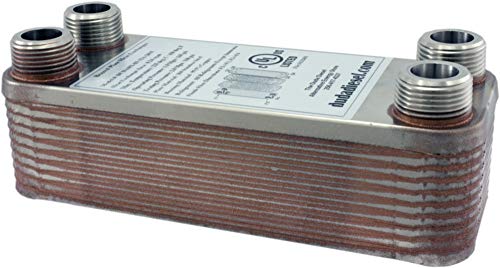
Built with 304 stainless inner plates brazed to pure copper, this unit emphasizes extreme design flexibility with high design temperature and pressure capabilities. Its compact dimensions (7.5″ length, 2.9″ width, 2″ height) make it suitable for compact HVAC or refrigeration retrofits while maintaining robust heat transfer performance.
Performance ranges from 3,400 to 17,000 BTU/hour depending on circuit configuration. Design pressure reaches up to 145 psi and test pressure up to 290 psi, supporting demanding commercial or industrial cooling and heating tasks. The product’s copper-brazed stainless steel construction offers strong resistance to corrosion and thermal stress.
AB 4×12 Inches Plate Heat Exchanger, 30 Plates

This larger 30-plate AB exchanger expands capacity to handle higher flow and heat-transfer demands. It maintains the same high-quality 316L stainless steel construction with copper brazing at the edges for durability and leak resistance. It’s designed for continuous operation in floor heating, water heating, and snow-melt setups.
With 250,000 – 330,000 BTU/hour capacity and a 1″ MPT port, it’s well-suited for medium to large radiant systems or commercial hydronic circuits requiring steady, efficient heat exchange and reliable performance under varying loads.
FIQUKI 4×12 Inch 20 Plates Plate Heat Exchanger

FIQUKI’s unit emphasizes advanced heat-transfer efficiency with a unique plate design that promotes turbulence and reduces secondary-side pressure drops. The 20-plate, 4″x12″ configuration integrates 316L stainless steel with high-purity copper brazing, delivering robust performance in water heating, floor heating, or industrial refrigeration contexts.
The quick-connect interfaces simplify installation, enabling fast assembly and servicing. The ultra-thin stainless plates optimize thermal conductivity, contributing to energy savings and lower operating costs over time, while maintaining strong resistance to corrosion and high-temperature operation.
Rebrisbol Brazed Plate Heat Exchanger 3×8 20 Plates

Rebrisbol offers a compact 3″x8″ 20-plate exchanger with copper-brazed 316L stainless steel plates. The design supports two separate flow channels, enabling flexible deployment in co-current or counter-current configurations. It emphasizes resistance to pressure and temperature fluctuations, corrosion, and provides robust performance across heating and cooling cycles.
Key parameters include 3/4″ MNPT ports, a designed pressure of 4.5 MPa, and a broad operating temperature range from -180°C to 200°C. The compact form factor suits tight installations in HVAC retrofits, refrigeration, and hydronic systems seeking efficient heat transfer in a small footprint.
Buying Guide: Key Considerations for Plate Heat Exchangers
- Capacity and plate count: Match BTU/hour requirements with the number of plates; more plates generally increase heat transfer capacity.
- Materials and brazing: Monitor corrosion resistance and pressure tolerance. 316L stainless steel with copper brazing offers durability and efficient heat transfer.
- Port size and connection type: Ensure MPT or MNPT port sizes align with your piping; consider quick-connect options for easier installation.
- Flow arrangement: Decide between co-current and counter-current flow based on desired temperature differential and pumping energy.
- Temperature and pressure ratings: Check design and test pressures to ensure compatibility with system operating conditions.
- Physical footprint: Larger capacities often require bigger footprints; verify space constraints in mechanical rooms or equipment closets.
- Maintenance and accessibility: Look for units with easy disassembly or cleaning features to reduce downtime.
- Cost of ownership: Evaluate energy savings from higher efficiency against initial cost and installation complexity.
- Warranty and support: Prefer brands with solid warranties and responsive customer service.