When selecting a vibration sensor for motor monitoring, accuracy, ruggedness, and compatibility with your system matter most. This guide highlights five highly relevant options, spanning industrial-grade RS485 sensors to smart Zigbee devices and compact vibration motor modules. Each choice is evaluated for real-world usefulness in motor monitoring, diagnostics, and control. Use this overview to compare features, integration ease, and environments where each device shines.
Summary of selected products
| Product | Brand | Key Benefit | Link |
|---|---|---|---|
| WTVB01-485 Vibration Sensor | WITMOTION | 3-axis data and IP68 ruggedity for industrial use | |
| THIRDREALITY Zigbee Vibration Sensor | THIRDREALITY | Smart home integration with adjustable sensitivity | |
| SW-420 Vibration Sensor Module | EC Buying | Digital output with simple Arduino integration | |
| ADXL345 Vibration Sensor Kit | ENOMAKER | Precise 3-axis sensing for accurate vibration analysis | |
| PWM Vibration Motor Switch Module | GODIYMODULES | Smooth control of vibration motors for silent alerts |
WITMOTION WTVB01-485 Vibration Sensor

The WTVB01-485 is a robust vibration sensor designed for industrial environments. It supports RS485 Modbus RTU with an accuracy of ±5% FS and real-time capture of three-axis data, including acceleration, angular velocity, and various displacement metrics. Features like on-chip timing and temperature monitoring aid maintenance planning. Its IP68-rated aluminum housing and strong magnetic attachment ensure reliable operation on equipment subject to harsh conditions. This sensor is suitable for early fault detection in motors, gearboxes, and pumps, enabling preventive maintenance and downtime reduction.
Key capabilities include: 3-axis measurements, wide operating range, and rugged construction. The device is ideal for plants or machinery requiring remote monitoring with reliable wired connectivity. In environments with electrical noise or harsh conditions, the sensor’s shielding and robust housing help maintain signal integrity. The broad data set supports trend analysis, resonance checks, and motor health diagnostics over time.
THIRDREALITY Zigbee Vibration Sensor

The THIRDREALITY Zigbee Vibration Sensor provides smart-home friendly monitoring with a 110 dB optional siren and adjustable sensitivity. It supports Zigbee 3.0, enabling seamless integration with popular brands such as Echo devices, SmartThings, Home Assistant, and Hubitat. With manual sensitivity adjustments via two switches, you can tailor alerts for various locations such as machinery rooms, drawers, or storage boxes. A physical mute switch offers flexible quiet notifications for environments where audible alerts are undesirable.
For motor-related monitoring, this sensor excels in delivering timely alerts and actionable data to connected hubs. Its wireless design simplifies installation on moving or difficult-to-reach machinery. The combination of local alert options and cloud or hub-based analytics enables proactive maintenance planning and faster response to vibration anomalies in production lines or robotics.
EC Buying SW-420 Vibration Sensor Module
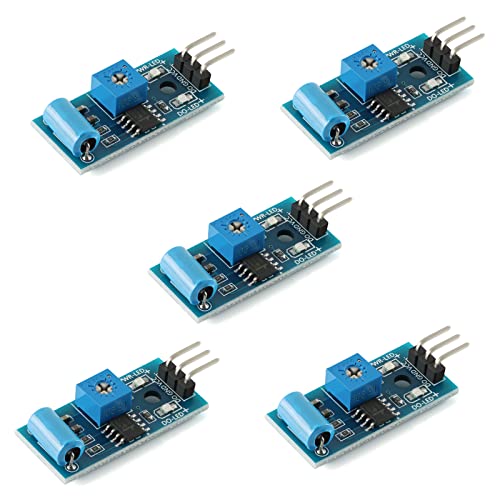
The SW-420 vibration sensor module is a compact, digital switching device suited for Arduino projects and basic motor monitoring tasks. With a digital output and a working voltage range of 3.3V-5V, it uses a LM393 comparator to deliver reliable on/off signaling when vibration exceeds a preset threshold. Its simplicity makes it a popular choice for hobbyists and educational labs experimenting with vibration-triggered actions, alarms, or simple fault detection in small motors or mechanical assemblies.
While not as feature-rich as industrial sensors, its ease of use and low cost make it a practical option for quick monitoring setups or prototyping. For more demanding industrial environments, pairing it with higher-end sensors or multiple units can provide baseline data and quick anomaly detection across a small motor array.
ENOMAKER ADXL345 Vibration Sensor Kit

The ENOMAKER kit features an ADXL345-based sensor, offering precise 3-axis acceleration data for accurate vibration analysis. Ideal for XY-axis control on 3D printers and other precision machinery, it helps reduce mechanical ringing and improve stability by providing high-fidelity measurements. The kit is designed to support more advanced data collection and analytics, allowing developers to translate raw acceleration data into actionable motor health insights. It is particularly suitable for research labs, educational settings, and enthusiasts working on vibration compensation and motor control optimization.
Users benefit from the ADXL345’s sensitivity and resolution, enabling detection of subtle vibration trends that may indicate bearing wear, misalignment, or structural resonance. For motor monitoring, this sensor can be integrated with microcontrollers and data loggers to build custom health dashboards and alerting systems.
GODIYMODULES 2Pcs PWM Vibration Motor Switch Module

This pair of PWM vibration motor switch modules is designed to control vibration motors with precision. The 5V DC input supports motors with a minimum vibration of 9000 RPM. The modules enable silent or near-silent signaling in robotics, haptic devices, or alert systems by modulating motor activity through PWM signals. They’re suitable for microcontroller projects, testing motor response to varying duty cycles, and building compact vibration alert mechanisms for devices where audible alarms are undesirable. The modules emphasize compact form, straightforward integration, and reliable 5V operation.
In motor monitoring and control contexts, the combination of a motor switch module with a suitable sensor can enable robust, adjustable vibration signaling and feedback loops. This pairing supports experiments with vibration-based alerts, haptic feedback, and mechanical signaling in automated systems or consumer electronics prototypes.
Buying Guide: Key Considerations For Choosing A Vibration Sensor For Motors
- Application environment: Industrial settings demand rugged IP-rated housings, EMI resistance, and stable signal transmission. For home or small labs, compact modules and Zigbee-enabled devices offer easier setup.
- Sensor type and data: Choose between 3-axis acceleration sensors for detailed vibration analysis (ADXL345) and simpler digital switches (SW-420) for threshold-based alerts. Consider RS485 Modbus if you need robust wired communication in noisy environments.
- Connectivity and integration: Zigbee sensors fit smart-home ecosystems and lighting or HVAC controls. RS485 and USB-based data logging suit industrial dashboards and edge computing setups.
- Response and resolution: Higher sampling rates and broader dynamic ranges enable early fault detection and precise diagnostics. Ensure the sensor’s specifications meet your motor’s speed and vibration range.
- Power and mounting: Verify voltage requirements and mounting options. IP ratings, magnet attachments, and rugged housings affect installation and longevity on rotating equipment.
- Cost and scalability: Start with a proven sensor for your initial tests, then scale with multiple devices or a combined sensor-and-motor control approach to cover larger equipment footprints.
- Data analytics: Plan for how collected data will be stored and analyzed. Some sensors offer built-in cloud or hub integrations, while others require local data loggers and dashboards.
Selecting the best vibration sensor for motor applications involves balancing measurement fidelity, environment, and integration simplicity. Industrial teams may favor WITMOTION’s rugged RS485 sensor for long-term monitoring, while makers can leverage SW-420 or ADXL345-based kits for rapid prototyping. For smart-building or paired-control scenarios, Zigbee-enabled options deliver seamless integration with existing ecosystems. In any case, aligning sensor capabilities with motor characteristics and maintenance goals will yield the most actionable insights and reduce unscheduled downtime.