Choosing the right steel balls for ball milling can impact grinding efficiency, wear resistance, and overall longevity of your equipment. This guide highlights five top options, spanning precision chrome steel and varied sizes to fit a range of mill configurations. Each product is evaluated on material quality, finish, and durability to help you select reliable, long-lasting media for your projects.
The table below summarizes five leading steel ball options based on common ball-mill needs. Use this as a quick-reference before diving into detailed product profiles.
| Product | Brand | Diameter / Size | Notable Features |
|---|---|---|---|
| 100 PCS 3/8″ Hardened Chrome Steel Balls | Vigorous | 3/8″ (9.525 mm) | Mirror polished, high hardness, wear resistant |
| Avler 1/2 Inch Steel Bearing Balls | Avler | 1/2″ (12.7 mm) | Chrome steel, well-rounded, no flat spots |
| PGN Bearings 3/4″ Chrome Steel Balls | PGN Bearings | 3/4″ (19.05 mm) | G25 grade, ISO 9001:2008 |
| BC Precision 1/2″ Chrome Steel Balls | BC Precision | 1/2″ (12.7 mm) | G25 grade, standard diameter |
| Breezliy 1″ Chrome Steel Balls G25 | Breezliy | 1″ (25.4 mm) | Precision ball, corrosion resistant |
Vigorous 3/8″ Chrome Steel Bearing Balls

Material: High-precision chrome steel (AISI 52100), well-known for bearing applications. The balls feature a mirror-polished surface, providing a shiny, smooth finish that reduces friction. These balls offer high hardness and load capacity, enhancing wear resistance for extended operation life. Suitable for medium-size milling setups where consistent ball geometry supports uniform grinding action.
Avler 1/2 Inch Steel Bearing Balls

Material: Chrome steel with uniform roundness and no flat spots. Each ball weighs approximately 8.4 g, offering a balanced mix of mass for effective milling and minimized cycloidal motion. The chrome steel composition provides robust hardness and good wear resistance, making these balls suitable for general ball-mill tasks requiring consistent grinding media geometry.
PGN Bearings 3/4″ Chrome Steel Balls
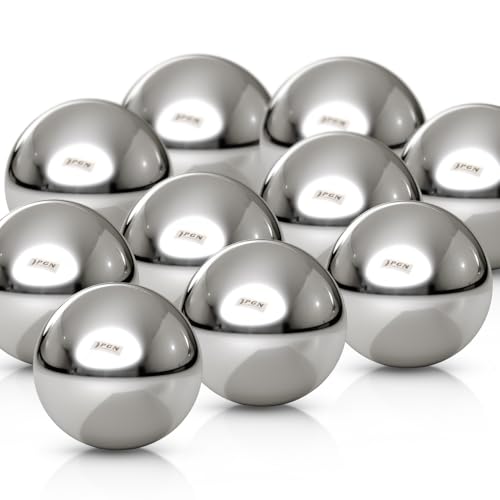
Diameter: 3/4″ (19.05 mm). These G25 chrome steel bearing balls are backed by ISO 9001:2008 quality standards, offering higher quality and durability. The design emphasizes reduced replacement and maintenance costs through improved hardness and wear resistance, making them well-suited for larger mills or applications requiring heavier grinding media.
BC Precision 1/2″ Chrome Steel Balls

Diameter: 1/2″ (12.7 mm); Grade: 25. These balls are built to standardize grinding media in lab and industrial mills. The G25 specification indicates reliable hardness and good wear properties, supporting long service life in continuous milling operations where uniformity is critical for predictable throughput.
Breezliy 1″ Chrome Steel Balls G25

Diameter: 1 inch (25.4 mm). These G25-grade chrome steel balls are designed with corrosion resistance and high hardness in mind, offering durability in larger milling setups. The packaging often ensures the balls remain free of cracks and chips, contributing to long-term, consistent grinding performance across batches.
CVGY 1″ Chrome Steel Bearing Balls

Material: High-hardness chrome steel with corrosion resistance and smooth, burr-free surfaces. The package includes two 1″ balls, designed for reliable performance in larger-ball-mill configurations. Heat treatment and precision machining help maintain roundness and reduce deformation under load, stabilizing milling action over time.
BORDSTRACT 20Pcs Threaded 10mm Steel Balls

Diameter: 10mm; These threaded steel balls are intended for replacing magnetic ball joints in Kossel K800 3D printers, but their robust stainless steel construction and threaded design extend beyond 3D printing applications. They offer versatile use in precision machinery and hardware, with strong hardness and wear resistance to support long service life in demanding environments.
Buying Guide: Key Purchase Considerations
When selecting steel balls for ball milling, consider material quality, size consistency, and finish. Chrome steel (AISI 52100) is a common choice for its hardness and wear resistance, but the specific grade (such as G25) and tolerance can affect milling efficiency. Larger diameter balls deliver faster milling for coarse materials but may reduce surface area contact, while smaller balls improve grinding fineness but require longer milling times. Surface finish, roundness, and absence of flat spots influence motion and energy transfer inside the mill. For corrosive environments or mixed-media setups, stainless variants or rust-resistant finishes can extend life. Finally, verify compatibility with your mill’s agglomeration tendencies and lid clearances to prevent jamming or uneven wear.
Durability and maintenance are important factors. ISO or industry-standard quality certifications (for example, ISO 9001:2008) can indicate consistent manufacturing processes and reliable hardness. In medium to large mills, using a mix of sizes can optimize grinding efficiency by balancing impact and grinding surface. For hobbyist or educational setups, smaller, uniform batches with tight tolerances reduce the risk of irregular grinding. Finally, consider packaging and labeling for easy inventory management and replacement planning.
Performance expectations should align with application type. For brittle materials, harder balls and precise surface finishing can reduce fragmentation and heat buildup. In high-throughput systems, wear resistance and stable roundness help maintain throughput and require fewer replacements. In all cases, ensure the balls are free of damage, chips, or flat spots before loading into the mill to avoid introducing inconsistencies into your grind.