Finding reliable stainless steel round bar suppliers helps keep projects running smoothly, from machining and fabrication to maintenance and repair. This guide highlights five well-regarded options, focusing on commonly used alloys and standard sizes. Each listing includes key specs, typical applications, and practical considerations to compare options quickly for American buyers.
Summary of selected products:
| Product | Brand | Diameter | Length | Alloy / Finish |
|---|---|---|---|---|
| 304 Stainless Steel Round Bar, Unpolished (Mill) Finish, Annealed, 0.75″ x 48″ | Online Metals | 0.75 inches | 48 inches | 304, Mill Finish, Annealed |
| 304 Stainless Steel Round Bar, Unpolished, Annealed, 0.375″ x 36″ | Online Metals | 0.375 inches | 36 inches | 304, Annealed |
| 12″ Long 3/4″ Round Rod 304 Stainless Steel | MOKOVI | 0.75 inches | 12 inches | 304, Stainless, Smooth Finish |
| 416 Stainless Steel Round Bar, 1.5″ x 12″ | Online Metals | 1.5 inches | 12 inches | 416, Mill Finish |
| 416 Stainless Steel Round Bar, 1″ x 36″ | Online Metals | 1 inch | 36 inches | 416, Mill Finish |
304 Stainless Steel 0.75″ Round Bar — Online Metals

This 304 stainless steel round bar is a standard choice for many fabrication and machining tasks. The alloy provides solid strength and corrosion resistance suitable for general-purpose use. The bar is supplied in a mill finish and annealed, offering good formability and ease of machining for various applications. Dimensional tolerances align with common commercial standards, making it compatible with a wide range of tools and fixtures in workshops.
304 Stainless Steel Round Bar, 0.375″ x 36″ — Online Metals
This smaller-diameter 304 round bar provides a balance of high strength, corrosion resistance, and machinability ideal for intricate components, bushings, or hobbyist projects. Annealed for ease of forming, it suits precise milling and turning tasks. Its 36-inch length supports multiple parts from a single cut and reduces waste in small shops or prototyping environments.
12 Inch 0.75″ 304 Stainless Rod — MOKOVI

The 0.75″ diameter solid rod from MOKOVI is sized for hobby projects and small-scale manufacturing. Its 304 stainless steel composition provides rust resistance, with a smooth surface that is easy to shape and weld. The 12-inch length is well-suited for shafts, spacers, or DIY mechanical parts. The finish is smooth enough to avoid significant prep work before machining or plating.
416 Stainless Steel Round Bar, 1.5″ x 12″

416 stainless steel emphasizes machinability with sufficient corrosion resistance for many applications that do not require the highest corrosion protection. The 1.5″ diameter offers a robust option for components that demand strength and easier turning or milling operations. Suitable for mid-range loads and fasteners, this bar is a practical choice for shops prioritizing ease of machining.
416 Stainless Steel Round Bar, 1″ x 36″

This 416 round bar is optimized for machining performance in applications where tool wear and speed matter. While it does not offer the highest corrosion resistance, it provides dependable machinability and structural integrity for precision parts, fixtures, and components that require accurate tolerances over medium lengths. The 1″ diameter and 36″ length support a variety of fabrication workflows in industrial settings.
17-4 Stainless Steel Round Bar, Ground, 1.75″ x 12″
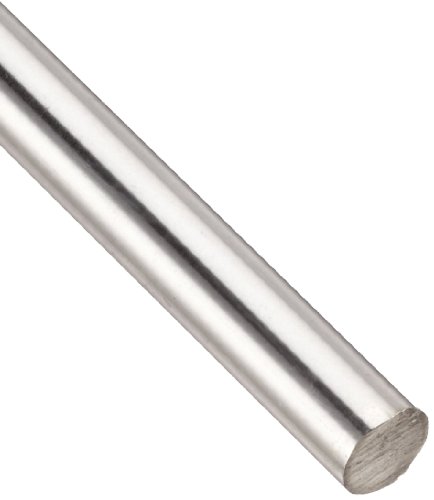
17-4 stainless steel combines high tensile strength and hardness with excellent corrosion resistance at elevated temperatures. This material is widely used in aerospace, automotive, and tooling applications where demanding mechanical properties are essential. The 1.75″ diameter and 12″ length make it suitable for drives, shafts, or high-stress components that benefit from a balanced combination of strength and corrosion resistance.
316 Stainless Steel Round Bar, 1.75″ x 24″

316 stainless steel is renowned for superior corrosion resistance, particularly in marine or highly aggressive environments. This alloy’s combination of strength and resistance makes it a preferred choice for components exposed to moisture, salt, or chemical exposure. The 1.75″ diameter and 24″ length support rugged industrial parts, fittings, and fixtures requiring dependable longevity in tough conditions.
304 Stainless Steel Round Bar, 1.5″ x 12″
This 304 bar offers a larger 1.5″ diameter with a compact 12″ length, a typical choice for machine shops needing a sturdy bar for fixtures, bushings, or shafts. The annealed finish aids with cutting and shaping while preserving corrosion resistance. It is suitable for general-purpose machining where moderate dimensions and reliable stainless performance are required.
Buying Guide: Key Purchase Considerations for Stainless Steel Round Bars
- Alloy selection: 304 and 316 offer good corrosion resistance, with 316 excelling in marine or highly corrosive environments. 416 focuses on machinability, while 17-4 provides higher strength and heat resistance.
- Finish and heat treatment: Mill finish and annealed stocks are easier to machine and form. Finishes can affect weldability and further processing, so choose based on subsequent fabrication steps.
- Diameter and length: Ensure the bar dimensions align with your machining plans, fixtures, and stock utilization. Longer lengths can reduce waste in batch runs.
- Machinability versus corrosion: A trade-off often exists. Bars like 416 are easier to machine, but corrosion resistance may be lower than 304 or 316.
- Supplier reliability: Consider lead times, batch consistency, and documentation such as material certifications and traceability for compliance-heavy projects.
- Application environment: For coastal or chemical exposure, prioritize 316 or higher-grade alloys. For general hardware or tooling, 304 and 416 can be cost-efficient options.
- Availability and compatibility: Check stock availability of the required diameters and lengths, and verify that the supplier can meet volume demands or custom cutting services.
With these considerations, buyers can compare options across common stainless steel round bars and select the best fit for fabrication, assembly, or maintenance tasks. When evaluating suppliers, prioritize material consistency, adherence to standards (like ASTM and AMS specifications), and transparent product data to ensure dependable performance in your operations.