Finding the right rubber-like 3D printing resin is essential for creating flexible, impact-resistant parts. Below are five leading options, highlighting elasticity, durability, and temperature performance to help you choose the best fit for prototypes, wearables, or flexible components.
| Product | Brand | Notable Feature | Shore Hardness |
|---|---|---|---|
| Superflex 3D Printer Resin | 3DMaterials | Balanced softness and strength for rubber-like prototypes | 80A |
| Tenacious Flex | Siraya Tech | Soft, rubber-like elasticity with fast rebound | Flexible (non-shore value stated; very soft) |
| RESIONE F69 Flexible Resin | RI RESIONE | Rubber-like, high tear strength and flexibility | 60–75A (soft to flexible range) |
| RESIONE F39 Flexible Resin | RI RESIONE | Soft yet tough; high elongation and tear resistance | 60–75A |
| Inslogic Flexible 70A Resin | Inslogic | Elastic, bendable, and durable for wearable parts | 70A |
Note: All prices and availability may vary by retailer. This guide focuses on resin properties that influence flexibility, resilience, and durability across typical 3D printing workflows.
Superflex 3D Printer Resin — 80A Simulated Rubber
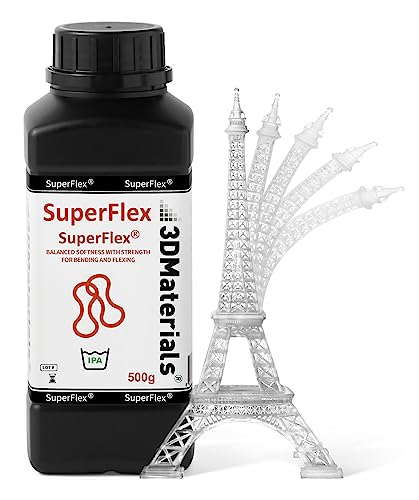
Brand: 3DMaterials | 500g | Clear
- Fast Printing: 50μm layer in 1.7 seconds on monochrome LCD printers, reducing print time and energy use.
- Productivity Boost: Claimed to raise farm productivity by at least 40% due to faster cures.
- Balanced Softness and Strength: 80A shore hardness designed to simulate rubber while maintaining structural integrity for prototypes.
Siraya Tech Tenacious Flex Resin — Flexible Black
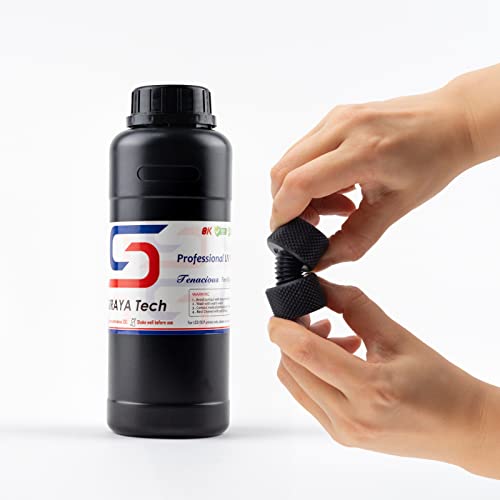
Brand: Siraya Tech | 500g | Flex Black
- Soft, Rubber-Like Flexibility: More rubber-like than classic Tenacious, with faster rebound for dynamic prints.
- Enhanced Elasticity: Excellent ability to bend and return to shape, supporting flexible, resilient parts.
- High Impact Resistance: Durable against drops or knocks while preserving detail and accuracy.
RESIONE F69 Flexible 3D Printer Resin — 1 Kg

Brand: RI RESIONE | 1Kg | Black
- Rubber-Like Flexibility: Shore 60–75A with good tear and folding resistance, soft above 20°C and harder at lower temperatures.
- Superior Tear Strength: Designed to resist tearing during bending and repeated flexing.
- Wide Application: Suitable for versatile parts like seals, gaskets, and flexible prototypes.
RESIONE F39 Flexible 3D Printer Resin — 1 Kg

Brand: RI RESIONE | 1Kg | Black
- Tear Resistance: Enhanced tear strength to resist damage during use.
- High Elongation: 255% elongation supports bending and stretching without failure.
- Soft Like Rubber: Shore 60–75A with temperature-dependent softness and impact resistance at lower temperatures.
Inslogic Flexible 70A Resin — 1Kg
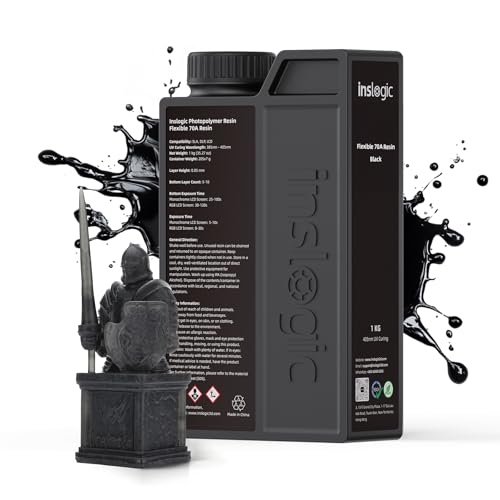
Brand: Inslogic | 1Kg | Black
- Rubber-Like Elasticity: True 70A elasticity for comfortable, bendable parts.
- Exceptional Tear Resistance: Durable for thin or detailed sections without tearing.
- Flexible Under Pressure: Maintains shape under bending, twisting, and compression.
Smooth-On XTC-3D Mold Coating — 6.4 oz

Brand: Smooth-On | 6.4 oz
- Coating For Finishing: Clear top coat to smooth and finish 3D printed parts, compatible with multiple printers.
- Finish Versatility: Suitable for SLA, SLS, and other rigid media plus PLA and ABS.
- Work Time and Cure: Mix ratio 2A:1B; 10-minute work time; cures to a hard, 80D shore coating in 3.5 hours.
Buying Guide: Key Considerations For Rubber-Like 3D Printer Resins
When selecting a rubber-like resin for 3D printing, consider elasticity, tear resistance, temperature performance, and post-processing needs. Flexible resins can deform under cold conditions, so environments with lower temperatures may alter hardness. The balance between softness and strength affects print durability and application scope, from wearable parts to prototypes and seals. Temperature tolerance, recovery after bending, and elongation at break determine if a resin will meet your specific use case. Additionally, printer compatibility—MSLA, DLP, or LCD—and exposure settings influence resin performance. For industrial applications, resins with higher tear resistance and dimensional stability reduce failure risk. In consumer prototypes, a softer resin with quick rebound can improve tactile feel and user experience. Finally, consider cost-per-part, resin handling safety, and post-curing requirements to optimize total production efficiency.
Across these options, users typically seek a resin that delivers rubber-like flexibility without sacrificing print fidelity. The listed products vary in hardness, elasticity, and resilience, offering choices for soft gaskets, flex joints, protective housings, and wearable components. Compare their shore ranges, elongation percentages, and temperature behavior to align with your project’s mechanical demands and environmental conditions.