Metal-filled filaments offer a distinctive metal look and feel for 3D printed parts, with options ranging from magnetic textures to rust-prone patinas. This guide highlights five top metal filament choices that balance printability, durability, and finish quality for American makers and hobbyists. Each pick is evaluated on texture, compatibility, and post-processing potential to help you choose the right filament for your project.
style=”display:none;”>Summary Table of Chosen Products
| Product | Brand | Highlights |
|---|---|---|
| AMOLEN 3D Printer Filament — Metal PLA | AMOLEN | Magnetic, 20% iron powder, matte black finish |
| ELEGOO Metal PLA Filament 1.75mm Bronze | ELEGOO | Genuine metal filling, metallic sheen, accurate diameter |
| Proto-Pasta Stainless Steel Filled PLA | Proto-Pasta | 60% stainless steel by weight, high density, patina-friendly |
| Geeetech Silk PLA Filament | Geeetech | Silk-like shine, dimensional accuracy ±0.02 mm |
| ANYCUBIC Silk Filament — Metal-Like PLA | ANYCUBIC | Metallic surface, smooth finish, ACE Pro compatibility |
AMOLEN Metal PLA Filament — Magnetic 20% Iron Powder

AMOLEN’s Metal PLA filament uses a 1.75 mm diameter with 20% iron powder, delivering a distinctive matte black finish and magnetic properties. The formulation supports sanding and polishing to achieve varied metallic textures, from rough industrial looks to smooth, shiny surfaces after finishing. Printing is described as having good shaping, odor control, and minimal warping, with an extrusion range of 200–220°C and a bed in a broad 0–50°C range. The filament is positioned for small functional parts that can be magnetically engaged, such as screws, caps, and lightweight assemblies.
ELEGOO Metal PLA Filament 1.75mm Bronze
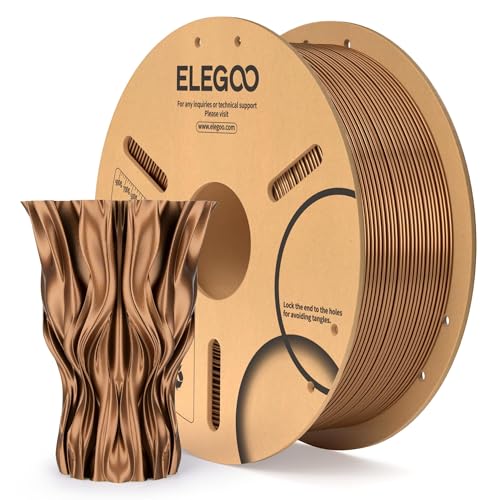
ELEGOO’s 1.75 mm Bronze filament is a metal-filled PLA with authentic metal content that yields a striking metallic sheen suitable for decorative pieces and sculptures. The filament emphasizes dimensional accuracy and consistency, with tight tolerances supporting smooth feeding and stable extrusion. Its full mechanical winding and manual checks are designed to reduce tangling, helping maintain print quality on longer runs. This makes it a practical choice for artistic models and display items that benefit from a genuine metal-like appearance.
Proto-Pasta Stainless Steel Filled PLA

Proto-Pasta Stainless Steel Filled PLA blends PLA with 60% stainless steel by weight, delivering a dense, metallic look and feel. It is particularly suitable for prints that are meant to be polished or patinated to simulate authentic metal surfaces. The material is compatible with most consumer FDM printers and prints smoothly with minimal clogging. It’s ideal for modeling tools, vehicle parts, and decorative items that require a convincing metal presence. Post-processing options include polishing and patinas to enhance the steel-like appearance.
Geeetech Silk PLA Filament — Silver Silk

Geeetech Silk PLA Filament features a silky shiny color with a metal-like appearance. The silver finish delivers a glaze-like surface without post-coating, producing glossy results suitable for decorations, cosplay props, and display pieces. It emphasizes dimensional accuracy (±0.02 mm) and compatibility with standard 1.75 mm printers, with recommended printing temperatures in a typical PLA range. Its anti-warping formulation helps maintain print integrity across larger objects while still achieving a high-sheen aesthetic.
ANYCUBIC Silk Filament — Metallic PLA

ANYCUBIC Silk Filament blends a metallic sheen with the benefits of PLA, delivering a smooth, reflective finish that resembles polished metal. The Silk variant is designed to produce a high-gloss surface with minimal post-processing, making it suitable for armor models, display pieces, and decorative items. It includes an intelligent printing recognition feature when paired with ACE Pro, helping automate printing parameters for reliable results. Dimensional accuracy is typically within ±0.02 mm, supporting precise fits for functional prints.
Buying Guide
- Metal content and finish: Filaments range from matte metal looks (magnetic, iron-filled) to bright, reflective silks. Choose based on whether you need a subtle metallic appearance or a high-shine surface.
- Post-processing options: Some filaments accept polishing, sanding, and patinas to enhance realism. If you plan to apply finishing steps, confirm compatibility with sanding grits and chemical patinas.
- Print compatibility: Most metal-filled filaments use 1.75 mm diameter; verify your printer’s nozzle size and extrusion temperature range. Some filaments benefit from slower speeds or higher bed adhesion aids.
- Mechanical properties: Heavier metal content yields higher density and potential magnetic properties, but can also increase printing resistance and nozzle wear. Consider nozzle maintenance and potential retraction tuning.
- Post-processing risk and odor: While many metal-filled PLA options are designed for minimal odor and bubble-free printing, some users report more noticeable smoke or odor depending on heating and ventilation. Ensure proper safety practices.
- Finish flexibility: Silk or metallic SLF (silk-like finishes) provide easier-to-achieve shine with less post-processing, while solid metallics may require polishing for best results.
- Printer ecosystem: Some filaments offer compatibility with smart printers or recognition systems that optimize print settings for the material. If you use such features, review compatibility lists.
- Cost vs. benefit: Metal-filled filaments tend to be pricier than standard PLA. Assess whether the desired metallic look justifies the budget for your project.
In selecting a metal filament, consider your end-use: display pieces benefit from high-shine silks and patina-ready options, while functional parts may favor magnetic or dense metal-infused formulations for weight and authenticity. Each product above has strengths in texture, consistency, and post-processing potential to help you achieve a convincing metal finish in your 3D printed projects.