Finding the right magnetic chuck can boost precision and efficiency for lathe and milling operations. The selections below cover 6×12 inch to smaller formats, featuring strong magnetic force, fine pole spacing, and quick on/off controls for secure workholding and fast setup. Each option is evaluated for stability, surface integrity, and ease of use to help you pick the best fit for grinding, milling, or turning tasks.
| Product | Brand | Key Strength | Typical Use |
|---|---|---|---|
| TIANGUOHE Permanent Magnetic Chuck, 6×12 | TIANGUOHE | 100-120 N/cm², uniform magnetic field | Grinding, milling, lathe workholding |
| TECHTONGDA 6×12 Fine Pole Permanent Magnetic Chuck | TECHTONGDA | High-precision pole spacing | Thin/ delicate workpieces |
| HHIP 4×7 Dense Permanent Magnetic Chuck | HHIP | 100N pull, durable build | General magnetic holding |
| SHARS 4x2x1 Matched Aluminum CAST Magnetic Transfer Chuck | Shars | Parallel transfer capability | Transfer workholding and alignment |
| CME 6×6 Magnetic Sine Plate Chuck | CME | 0.0004″ accuracy, precise positioning | Sine plate reference for setups |
TIANGUOHE 6×12 Inch Magnetic Chuck
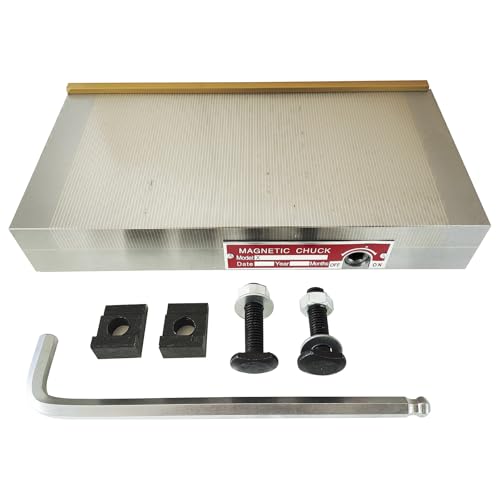
The TIANGUOHE 6×12 inch permanent magnetic chuck features a robust 100-120 N/cm² suction, designed with high-performance magnetic steel to deliver uniform holding force. The device supports vertical mounting on machine tools and minimizes workpiece scratching thanks to even pole spacing. Operation is straightforward: turn a shaft 180° to ON and 180° to OFF, with surface precision maintained during switching. This makes it suitable for grinding, milling, and lathe tasks where consistent clamping is essential.
TECHTONGDA 6×12 Inch Fine Pole Magnetic Chuck

The TECHTONGDA 6×12 inch chuck uses premium magnetic steel and delivers a 100-120 N/cm² suction. Its fine pole spacing promotes uniform magnetic force, which is especially advantageous for securing thin or small parts. An on/off handle provides a quick 180° turn to demagnetize, keeping the worktable surface flat and free of distortion during changes in setup. This design supports precise workholding without sacrificing surface integrity.
HHIP 4×7 Dense Permanent Magnetic Chuck
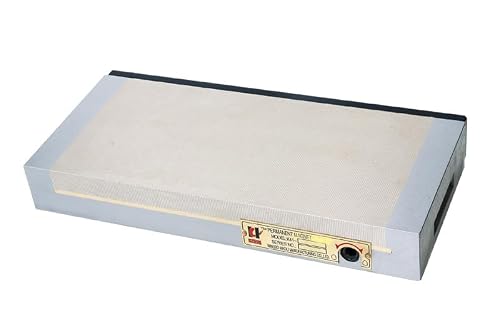
The HHIP 4×7 inch dense magnetic chuck provides a 100N pull with a compact form factor. Its design is suitable for various magnetic conduction workpieces and offers solid performance for grinding operations or as a lathe workholding surface. Weighing around 19 pounds, it provides a stable platform with dependable clamping across a range of small to mid-sized parts, while maintaining surface flatness for precise machining.
SHARS 4x2x1 Matched Aluminum CAST Magnetic Transfer Chuck

The SHARS transfer chuck is designed for parallel magnetic holding and transfer setups. Its matched aluminum cast construction emphasizes consistency, enabling precise parallelism and reliable transfer of workpieces between fixtures or stages. This option is ideal for workflow sequences that require repeatable alignments without sacrificing clamping stability during quick transitions.
CME 6×6 Magnetic Sine Plate Chuck

The CME 6×6 magnetic sine plate chuck offers precise positioning with a stated 0.0004″ accuracy between rollers. This makes it valuable for setups requiring high repeatability and accurate indexing, particularly in fixturing and alignment tasks common to milling and multi-step lathe operations. The compact footprint enables integration into existing setups without excessive space requirements.
Buying Guide
Key considerations when selecting a magnetic chuck for lathe or milling work include magnet strength, pole configuration, and surface compatibility. Higher suction forces improve workpiece retention on heavier parts, while fine pole spacing enhances grip on thin or delicate components without marring surfaces. On/off control should be quick and repeatable to minimize downtime, and surface flatness must be maintained during switching to preserve machining accuracy.
Other factors to evaluate are the chuck’s size and compatibility with your machine bed, the ease of cleaning to remove ferrous chips, and the ability to withstand vertical mounting when required. For smaller parts or intricate features, a fine-pole chuck can deliver more uniform holding across the surface. For repeatable transfer operations, a magnetic transfer chuck or sine plate offers alignment advantages and consistent clamping across cycles.
Versatility versus specialization is another consideration. A larger 6×12 inch chuck provides broad coverage for many parts, while compact 4×7 or 4×2 inch chucks excel with tight tolerances and precise placements. If your workflow includes both roughing and finishing passes, consider a model with a stable plane and minimal surface deviation after ON/OFF cycling. Finally, ensure any accessory or adapter compatibility with your existing tooling to maximize value and uptime.