Finding reliable liquid level sensors is essential for safety, automation, and process control across industries such as agriculture, aquaculture, chemical processing, and home automation. This guide highlights five top-performing sensors that cater to non-contact detection, capacitive sensing, and wired analog outputs. Each pick is designed to work with common platforms like Arduino or Raspberry Pi, while delivering robust performance in challenging environments. Below is a quick overview to help you compare key capabilities at a glance.
| Product | Brand | Key Advantage | Type |
|---|---|---|---|
| CQRobot Non-Contact Water/Liquid Level Sensor (Industrial) | CQRobot | Non-contact, high-speed processing, broad liquid compatibility | Capacitive / Non-Contact |
| CQRobot Capacitive Non-Contact Water Level Sensor | CQRobot | Capacitive sensing with adjustable sensitivity | Capacitive / Non-Contact |
| EC Buying XKC-Y25-V Non Contact Liquid Level Sensor | EC Buying | True non-contact, works through various non-metallic containers | Non-Contact |
| CQRobot Non-Contact Water Level Sensor for Pipelines | CQRobot | Pipeline-specific non-contact sensing with indicator | Capacitive / Non-Contact |
| Tangxi Liquid Level Sensor | Tangxi | 4-20mA analog output for precise monitoring | Analog / Industrial |
CQRobot Non-Contact Liquid Level Sensor for Industrial and Home Use

The CQRobot non-contact liquid level sensor detects liquid presence without touching the liquid, making it suitable for detecting toxic or hazardous substances in closed containers. It uses advanced signal processing and a high-speed processing chip to minimize the influence of container wall thickness. Installation is straightforward, and the device can detect levels in a wide range of liquids, including strong acids, bases, and other chemicals. The principle relies on inductive capacitance: as liquid comes close, parasitic capacitance is coupled to the sensor’s static capacitance, producing a measurable change that the control IC converts into a detectable signal. Threshold-based decision logic determines when the liquid reaches the sensing point.
CQRobot Capacitive Non-Contact Water Level Sensor

This sensor uses capacitive sensing to trigger liquid level signals based on changes in liquid capacitance. It offers high detection accuracy with a non-contact form factor and includes an indicator light for at-a-glance status. It is compatible with Arduino and Raspberry Pi and includes test code for quick setup. The device features a double DIP switch design: one side selects the signal voltage (3.3V or 5V) and the other reverses the detection output logic, allowing easy adaptation to diverse control systems and ensuring reliable operation in varying environments.
EC Buying XKC-Y25-V Non-Contact Liquid Level Sensor

This non-contact liquid level sensor uses advanced signal processing to achieve true non-contact performance, even through container walls of varying thickness. It has robust compatibility, capable of penetrating many non-metallic containers such as plastic, glass, or ceramic up to a sensing thickness of about 20 mm. It is suitable for detecting levels in curved or cylindrical containers, broadening its applicability for different tank designs and spaces where physical probes are impractical.
CQRobot Non-Contact Liquid Level Sensor For Pipelines

This model targets pipelines with a 3–10 mm diameter context, using capacitive sensing to detect changes in liquid capacitance and trigger the level signal non-contact. It includes an indicator light and adjustable sensitivity, with compatibility for Arduino and Raspberry Pi. The double DIP switch arrangement lets users set voltage and output logic to suit specific control schemes, delivering stable operation in tight piping configurations and industrial setups.
Tangxi Liquid Level Sensor: 4-20mA Industrial Transmitter
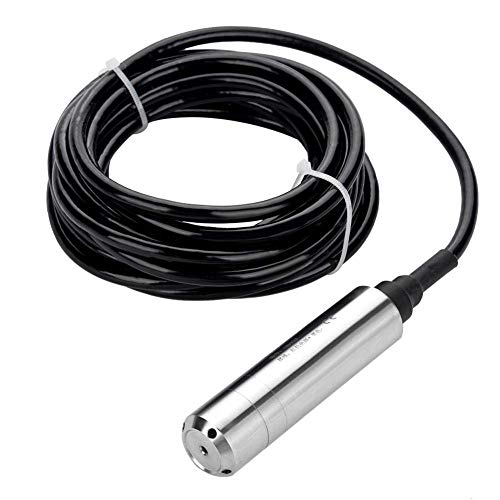
This industrial-grade sensor provides a 4-20mA analog output for precise liquid level monitoring. It is designed for reliable performance in challenging environments, offering a robust steel shell and anti-clogging construction. The sensor is suitable for integration with digital displays, PLCs, frequency converters, and recorders, making it a good choice for automation-heavy applications where continuous, scalable monitoring is essential.
Buying Guide: Key Purchase Considerations
When selecting a liquid level sensor, consider the following aspects to ensure you pick a device that meets your application needs.
- Non-contact vs. contact sensing: Non-contact sensors avoid direct liquid contact and are ideal for toxic or corrosive liquids, while contact sensors can offer straightforward wiring and robust outputs in rugged environments.
- Liquid compatibility: Some sensors handle a wide range of liquids, including acids or alkalis, while others are best with potable water or clear liquids. Confirm chemical compatibility for your fluid.
- Container type and material: Through-wall sensing works better on certain container materials (glass, plastic, ceramic) and shapes. Consider wall thickness and geometry when choosing a model.
- Output type and interface: Digital thresholds, analog 4-20mA, or compatibility with microcontrollers like Arduino or Raspberry Pi. Decide how you will read and act on the sensor output.
- Adjustability: Features such as adjustable sensitivity, output logic, and voltage levels help tailor the sensor to your control system and reduce false positives.
- Power requirements: Check supply voltage compatibility (3.3V/5V logic, 24V industrial systems) and whether the sensor integrates with existing power rails.
- Environmental conditions: Consider temperature range, humidity, and exposure to dust or splashes. Some sensors are designed for industrial environments; others are better for hobbyist setups.
- Maintenance and durability: Look for sensors with easy installation, minimal moving parts, and good IP ratings or enclosure protection for longevity.
- Installation footprint: Size and mounting options matter for tight spaces, pipelines, or tank tops. Ensure physical compatibility with your setup.
In practice, non-contact capacitive sensors excel when you need safe operation around hazardous liquids, while analog-output sensors fit integration with process control systems. For simple alerting or hobby projects, digital threshold sensors provide straightforward setup with clear status signals. Always verify compatibility with your container geometry, liquid type, and readout hardware before purchasing.