Industrial air filtration and ventilation are essential for keeping workshops safe, comfortable, and compliant. This guide highlights five highly capable filtration systems designed for wood shops, garages, and industrial spaces. Each option offers multiple speeds, effective particle capture, and user-friendly controls to maintain clean air during demanding projects.
| Product | Airflow (CFM) | Key Benefit | Power/Mode |
|---|---|---|---|
| WEN AF1270 | 750 / 950 / 1270 | Remote-controlled, high-capacity filtration | Three speeds, 1-micron and 5-micron filters |
| ABESTORM 1350 | 1050 – 1350 | 360-degree intake for broad coverage | Two speeds, strong vortex fan |
| ALORAIR 780IG | 580 – 780 | 270° intake with built-in ionizer | Two speeds, remote control |
| Xtreway 550CFM | Up to 550 | Three-stage filtration with HEPA and carbon | DC inverter motor, low noise |
| Abestorm 1080 | 780 – 1080 | 270° intake, ceiling-mounted versatility | Two speeds, remote control |
These products illustrate a range of configurations—from ceiling-mounted units to portable scrubbers—to address dust, odors, and fine particulates in American workshops and industrial spaces. Consider room size, filtration efficiency, noise tolerance, and installation options when evaluating options for your needs.
WEN AF1270 Industrial Air Filtration System
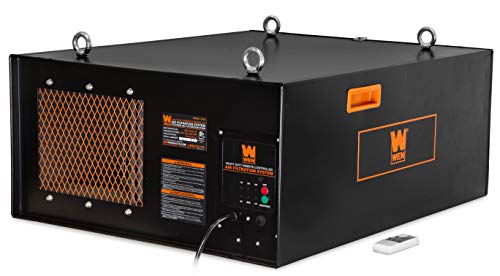
The WEN AF1270 offers three speeds and a high maximum airflow of up to 1270 CFM, making it suitable for mid-size workshops. It circulates air in larger spaces efficiently, with a 1-micron filter (model 3415AF1) and a 5-micron pre-filter (model 3415AF5) that are easily replaceable. Remote control adds convenience for sessions where manual adjustment is impractical. In spaces around 1000 square feet, this unit can renew air multiple times per hour, helping reduce dust and airborne particles.
Key considerations: ensure proper ducting or placement to maximize intake and discharge efficiency; factor in room dimensions to achieve the recommended air changes per hour. The included filters deliver reliable particle capture, while the three-speed design accommodates different project intensities.
ABESTORM 360 Degree Intake 1350 CFM
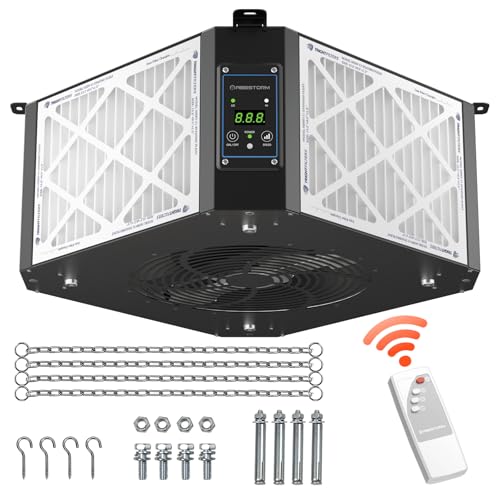
The DecDust 1350 model from ABESTORM features a 360-degree intake with a strong vortex fan, delivering 1050–1350 CFM depending on speed. It’s designed for woodworking environments and can help remove dust, wood chips, and fine particles from large spaces up to about 1700 square feet. A MERV-11 filter supports efficient removal of contaminants in the 1–10 μm range, with the system offering two speeds to balance airflow and noise. Its portable design makes it suitable for garages or shops that require flexible placement.
Key considerations: assess space layout to maximize the 360-degree intake; consider noise tolerance at higher speeds; verify filter replacement availability when planning long-term maintenance.
ALORAIR 780IG 270° Intake Filter System

ALORAIR’s 780IG features a 270° intake design with a built-in ionizer to enhance overall air quality by reducing odors and promoting particulate removal. It operates with two speed settings and a strong vortex fan, maintaining good airflow in larger workshops. The unit is intended for hanging or wall-mounted installation, suitable for spaces up to around 800 square feet. Low noise at 50 dBA helps maintain a quieter work environment while filtering dust from woodworking, grinding, or sanding tasks.
Key considerations: ionization can improve particle capture but may require ventilation compatibility checks in sensitive environments; verify mounting provisions suitable for ceiling or wall installation in your shop.
Xtreway 550CFM Three-Stage Air Scrubber

The Xtreway air scrubber offers a three-stage filtration system capable of capturing 99.97% of particles as small as 0.3 μm with HEPA and carbon filters. It supports up to 550 CFM and features a DC inverter motor with stepless speed control, allowing precise airflow customization for various tasks. The unit operates with relatively low noise, making it suitable for interior projects or occupied spaces. Its rugged construction is aimed at industrial use, including work sites and restoration projects.
Key considerations: check space coverage to determine if 550 CFM meets your needs; consider filter replacement frequency and overall running costs for ongoing projects.
Abestorm 1080 CFM Intake With Remote

Abestorm’s 1080 CFM ceiling-mounted filtration system uses a 270° intake design to capture dust effectively in woodworking shops and garages. It offers two-speed adjustment and remote control for convenient operation. The design supports flexible ceiling or wall mounting and is suited for spaces where ceiling placement is practical. The unit’s high airflow helps improve air quality quickly during heavy dust-generating tasks such as sanding or sawing.
Key considerations: ensure ceiling mounting hardware is appropriate for your space; verify accessibility of the remote control range and the ease of filter replacement in maintenance planning.
Buying Guide: Key Purchase Considerations And Comparisons
When selecting an industrial air filtration system, consider the following factors to align with your workspace needs:
- Room size and air changes per hour (ACH): Calculate the required CFM for your space to achieve comfortable air exchange. Larger rooms may require higher CFM units or multiple units for even distribution.
- Filtration stages and particle capture: Three-stage systems plus carbon or MERV-rated filters deliver better removal of dust, odors, and other contaminants. HEPA stages are especially effective for fine particles.
- Intake design and coverage: 270° or 360° intake improves capture area. Ceiling-mounted options can save floor space in tight workshops.
- Noise and comfort: Consider dBA ratings, especially for spaces where people work nearby. Lower noise models are beneficial for continuous use.
- Controls and convenience: Remote controls, timers, and auto modes help maintain air quality without constant manual adjustments.
- Maintenance and operating costs: Filter replacement frequency, filter availability, energy use, and total cost of ownership over time.
- Portability vs. fixed installation: Portable scrubbers offer flexibility; fixed ceiling or wall units provide permanent, space-saving solutions.
- Safety and compliance: Ensure the unit meets local regulations for dust control and ventilation in your industry, especially for wood-work or health-sensitive environments.
Bottom line: match the filtration capacity and intake design to your workshop’s size, dust load, and noise tolerance. Prioritize systems with interchangeable filters, remote control options, and clear maintenance schedules to sustain air quality over time.