When maintaining heavy equipment, selecting the right pressure washer helps remove stubborn grime, grease, and built-up dirt without damaging surfaces. This guide reviews five high-performance units designed to tackle decks, concrete, machinery parts, and vehicle fleets. Each model emphasizes power, portability, and accessory versatility to support frequent cleaning tasks across job sites, farms, and industrial settings.
| Product | Max PSI | GPM | Type | Key Benefit |
|---|---|---|---|---|
| Westinghouse ePX3500 Electric | 2500 | 1.76 | Electric | Anti-tipping design; onboard soap tank |
| Westinghouse WPX3000e Electric | 3000 | 1.76 | Electric | Induction motor; versatile nozzle set |
| Westinghouse ePX3100v Electric | 2100 | 1.76 | Electric | Detachable foam cannon; built-in carry handle |
| Westinghouse WPX3200e Electric | 3200 | 1.76 | Electric | High PSI for tough grime; built-in soap tank |
| SOORAITON 4200 PSI Gas | 4200 | 4.0 | Gas | Heavy-duty cleaning; 5 nozzles included |
Westinghouse ePX3500 Electric Pressure Washer

The Westinghouse ePX3500 delivers up to 2500 max PSI with 1.76 max GPM, or 2000 PSI and 1.2 GPM at rated flow. Its pro-style 17.5-inch steel wand with quick-connect nozzles (0°, 15°, 25°, turbo, and soap) supports diverse cleaning tasks from cars and fences to decks and driveways. A compact 19-pound unit with four quick-lock wheels and an anti-tipping design enhances stability on uneven surfaces. The onboard 20-ounce soap tank enables detergents for heavy-duty cleaning without frequent refills.
Westinghouse WPX3000e Electric Pressure Washer
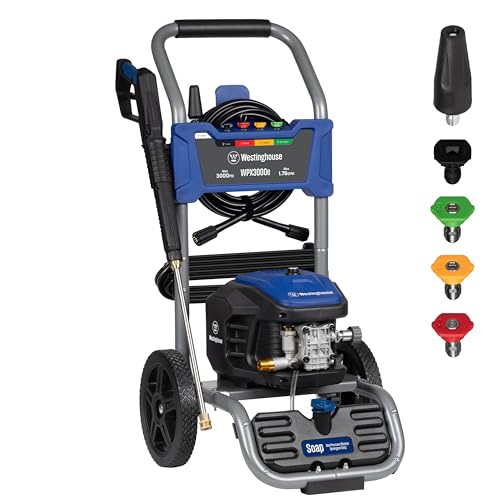
WPX3000e provides a robust 3000 max PSI and 1.76 max GPM, with a 2600 PSI rating at stress-tested flow. Its induction motor is designed for efficiency, and the 25-foot hose adds reach for large surfaces. The unit includes a 0°, 15°, 25°, soap, and turbo nozzle set and is compatible with accessories like surface cleaners and foam cannons through standard M22 fittings. An onboard .45-gallon soap tank supports detergent use across challenging jobs, from sidewalks to exterior walls.
Westinghouse ePX3100v Electric Pressure Washer

The ePX3100v hits 2100 max PSI and 1.76 max GPM, with a portable 18-pound design and a built-in carry handle. Its detachable foam cannon adds detergents for heavy-duty cleaning of decks, driveways, stairs, and vehicles. The 20-foot easy-coil hose keeps setup quick, while the enclosure and wand system provide reliable performance for frequent site work.
Westinghouse WPX3200e Electric Pressure Washer
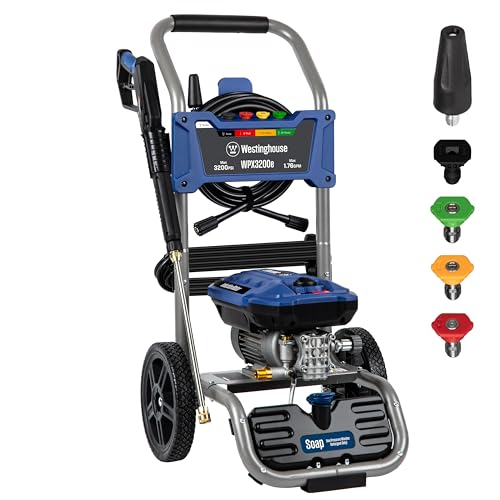
The WPX3200e combines 3200 max PSI with 1.76 max GPM for strong, consistent cleaning. It features a built-in 0.61-gallon soap tank and a 25-foot abrasion-resistant hose with a lightweight spray gun and 5 quick-connect nozzles (0°, 15°, 25°, turbo, soap). Its induction motor and long-lasting axial cam pump deliver reliable power for decks, fences, driveways, and posted equipment maintenance. The unit is designed for regular use in home and small industrial projects.
SOORAITON 4200 PSI Gas Pressure Washer

This gas-powered model delivers up to 4200 PSI and 4.0 GPM, making it a top choice for heavy-duty jobs such as siding removal, large driveways, and vehicle preparation. It runs on a rugged 212cc gasoline engine with a recoil start system and an axial cam pump for durability under heavy workloads. Included 5 nozzles cover a wide range of cleaning tasks, and a 1-liter soap tank supports use of detergents. The design emphasizes high performance for professional or frequent-use scenarios.
Steupoek 4200 PSI Gas Pressure Washer

Another 4200 PSI gas option, this unit emphasizes robust cleaning, including 32-foot hoses for extended reach and 5 nozzles (0°, 15°, 25°, 40°, 60°, plus soap) to tailor pressure for various surfaces. A 3-liter soap tank is included for detergent-assisted cleaning, and the unit is designed for heavy-duty outdoor use on patios, driveways, fences, and vehicles. The construction aims to balance power with user-friendly handling on job sites.
Buying Guide: Key Purchase Considerations
- Power source and duty cycle: Electric models tend to be quieter, with lower maintenance, suitable for residential and light industrial tasks. Gas models offer higher PSI and GPM for tougher grime and larger jobs but require more maintenance and fuel considerations.
- PSI and GPM balance: For heavy equipment and concrete surfaces, look for higher PSI (2000–4200) and a solid GPM (1.6–4.0). Higher PSI helps dislodge tough residue, while adequate GPM ensures continuous cleaning without excessive downtime.
- Portability and storage: Anti-tip designs, compact footprints, and wheels improve stability and maneuverability on uneven job sites. Lightweight models ease transport between locations.
- Nozzle versatility: A set of quick-connect nozzles (0°, 15°, 25°, turbo, soap) provides flexibility to clean delicate surfaces without damage and to apply detergents where needed.
- Detergent integration: An onboard or detachable soap tank reduces the need for frequent refills and supports detergent-based cleaning for grime, grease, and algae on surfaces like concrete, fencing, and equipment.
- Accessory ecosystem: Compatibility with surface cleaners, undercarriage cleaners, and foam cannons extends the machine’s usefulness across vehicles, machinery, and large outdoor areas.
- Maintenance and durability: Induction motors and axial cam pumps are typically more durable and require less frequent maintenance, especially in electric models. For gas units, consider engine reliability and available service options in your region.
- Noise and emissions: Electric washers are typically quieter and emission-free for indoor or semi-indoor work. Gas washers deliver raw power but generate more noise and exhaust; plan accordingly for worksite safety and local regulations.
- Cost of ownership: Evaluate initial price, maintenance needs, accessory availability, and expected usage. Heavier-use scenarios may justify higher upfront investment for durability.