Finding the right ground mount system is essential for maximizing solar gains while ensuring sturdy, long-term installation. This guide highlights top ground-mount options that pair durability with easy installation, helping you choose a reliable setup for open spaces, cabins, farms, or backyards. The products featured cover adjustable brackets, multi-piece frame kits, and rugged triangular supports designed to resist wind and sag. Read on for concise product insights and a practical buying guide to compare key features such as stability, load-bearing capacity, adjustability, and installation requirements.
| Product | Brand | Type | Core Benefit |
|---|---|---|---|
| ECO-WORTHY Upgraded Ground Mount | ECO-WORTHY | Multi-piece mounting brackets | High adaptability for multiple panel counts |
| ECO-WORTHY Solar Ground Mount System (Large) | ECO-WORTHY | Ground mount brackets with multi-triangle stability | Supports up to 5x400W panels, reinforced structure |
| ECO-WORTHY 4 Sets 45 Inch Tilt Mount | ECO-WORTHY | Tilt mount with foldable legs | Up to 25% efficiency boost |
| PFCTART 2 Sets 45 Inch Tilt Mount | PFCTART | Foldable tilt brackets | Tool-free tilt adjustment, versatile mounting |
| Dgavxa 4 Pack 45 Inch Tilt Mount | Dgavxa | Adjustable tilt brackets | High wind tolerance, easy single-handed angle change |
ECO-WORTHY Upgraded Solar Ground Mount System

The ECO-WORTHY upgraded ground-mount system is designed for flexible configurations to support varying solar panel arrays. This kit features a long 118″Lx39″W footprint with front and rear columns of different heights to optimize panel tilt and balance. It is built to support larger panels and includes an enhanced central support rod to reduce sag in the middle, improving overall stability for ground installations in open spaces, cabins, or backyard settings. The adjustable hole positions enable tilt ranges from 30° to 60°, promoting efficient sun capture and higher energy yield.
ECO-WORTHY Ground Mount For Large Installations
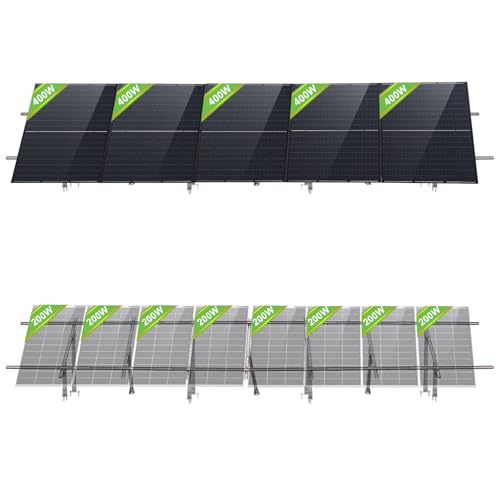
This Eco-Worthy ground-mount setup is built for scalability in large installations, designed to hold up to five 400W panels with a robust 330 lb load-bearing capacity. It employs a multi-triangular frame structure and a 59-inch spacing between vertical columns, with three central support rods and cement block bases recommended for extra rigidity. Seven preset tilt angles from 30° to 60° provide flexibility to maximize sun exposure across seasons, making it suitable for farms, sheds, or expansive off-grid sites where stability under wind load matters.
ECO-WORTHY 4 Sets 45 Inch Adjustable Tilt Mount

This tilt-mount kit from ECO-WORTHY emphasizes efficiency and adaptability, claiming up to a 25% boost in energy capture through an adjustable tilt system. It’s suitable for a broad range of off-grid scenarios, including RVs, boats, sheds, and ground setups. The design claims compatibility with arrays from 100W to 400W, making it a flexible option for mid-sized to larger installations seeking easier angle adjustments and reliable performance in varying sun conditions.
PFCTART 2 Sets 45 Inch Tilt Mount Brackets

PFCTART’s two-pack 45-inch tilt brackets offer a rugged, corrosion-resistant option for ground or roof applications. The kit supports modules in the range of roughly 100–500 watts and allows horizontal or vertical orientation, which helps tailor the layout for different yard or deck spaces. The tilt range is adjustable without tools, and the brackets are designed to be reliable in exposed environments, making them suitable for open-field installations or elevated ground sites where wind and weather exposure are considerations.
Dgavxa 4 Pack 45 Inch Tilt Mounts
Dgavxa’s 4-pack 45-inch tilt mounts are designed for ground or roof installations with 0–90° tilt range. The system emphasizes wind resistance and stability with lightweight yet sturdy aluminum rails. Built for 45-inch panel widths, these brackets are marketed toward RVs, cabins, and off-grid setups, where quick angle adjustments and reliable clamping are important for maximizing sun exposure while maintaining solid structural integrity in variable conditions. The brackets’ wind resistance is highlighted by a 2400Pa rating in related product lines, signaling strong performance in exposed environments.
Buying Guide: Key Considerations For Ground Mount Solar Systems
Categories and configurations matter depending on your site, local weather, and panel size. Here are essential considerations to compare when choosing a ground mount system:
- Stability and load capacity: Look for systems with reinforced frames, central supports, and stake or cement-base recommendations. Ground installations in windy regions benefit from multi-triangular structures and solid anchoring.
- Adjustability: Tilt range and angle presets affect annual energy yield. Systems offering 30°–60° or 0°–90° tilt provide flexibility for seasonal sun angles and different installation orientations.
- Panel compatibility: Verify the kit supports panel wattage and width in your array. Many kits advertise compatibility with 100–400W modules, while others target larger industrial setups.
- Ease of installation: Tool-free tilt adjustments and modular frames reduce labor time. Consider whether the system requires cement or heavy anchoring, and if it’s suited for temporary or long-term installations.
- Durability and materials: Aluminum rails resist corrosion; powder-coated components offer extra protection in harsh climates. For off-grid sites, check resistance to UV exposure and temperature swings.
- Maintenance and servicing: Consider ease of cleaning, accessibility for wiring, and potential need for periodic reinforcement, especially in exposed or remote locations.
- Warranty and support: Check the manufacturer’s warranty period and whether replacement parts are readily available to minimize downtime after installation.
- Site compatibility: Ground mounts require clear space, level soil or concrete pads, and proper drainage. If soil quality or frost heave is a factor, plan for anchors and base design accordingly.
Bottom line: The best ground mount system balances structural stability, panel compatibility, and adjustable tilt to maximize sun exposure with minimal maintenance. For larger installations, scalable multi-panel kits with reinforced frames may offer better value. For smaller setups or portable needs, tilt mounts with tool-free adjustments provide convenience and efficient performance. Evaluate local wind speeds, soil conditions, and available space to choose a configuration that suits your site and energy goals.