Choosing the right liquid nitrogen dewar depends on capacity needs, evaporation rates, portability, and ease of use. This guide compares top Dewars from reputable brands, focusing on models suited for laboratory, beauty, research, and educational settings. Each option prioritizes safe handling, rugged construction, and reliable insulation to minimize LN2 loss over time.
| Product | Brand | Capacity | Notes |
|---|---|---|---|
| Kit: Worthington D050-8C00 | Taylor Wharton | 25 L and larger | Safe filling, venting, and transferring; 8 L/min dispensing at 10 psi; 2-year guarantee |
| U.S. Solid 10L Cryogenic Container | U.S. Solid | 10 L | Designed for slower evaporation; tested evaporation rate |
| Magula 10L Liquid Nitrogen Dewar | Magula | 10 L | Aerospace aluminum construction; six canisters; compact design |
| VEVOR 20 L Liquid Nitrogen Tank | VEVOR | 20 L | Six canisters; carry bag with straps; vacuum insulation |
| CXRCY 10L Aluminum Dewar | CXRCY | 10 L | Six canisters; durable insulation; versatile storage |
Introduction notes: This comparison focuses on common capacities (3–20 L and larger), practical features for safe LN2 handling, and build quality. The selected models balance portability with storage duration, making them suitable for clinics, labs, beauty services, and educational demonstrations.
Worthington D050-8C00 Liquid Nitrogen System

The Worthington D050-8C00 system is designed for safe and efficient liquid nitrogen handling in larger dewars. It supports straightforward filling, venting, and transferring operations, which helps minimize spills and exposure. The unit dispenses LN2 at up to 8 liters per minute at a regulated 10 psi, enabling rapid transfers during experiments or clinical procedures. A two-year guarantee adds a layer of reassurance for facilities requiring dependable equipment. This model is particularly suitable for laboratories and industrial settings where higher throughput is necessary without sacrificing safety.
U.S. Solid 10L Cryogenic Container LN2 Tank

The U.S. Solid 10L cryogenic container emphasizes a balance between capacity and economy. It is built to hold a substantial LN2 load while prioritizing slower evaporation when possible. The dewar’s design targets stability and reliability for routine storage needs, making it a practical choice for educational labs, clinics, or smaller research facilities that require dependable LN2 containment without premium pricing.
Magula 10L Liquid Nitrogen Dewar

The Magula 10L LN2 dewar uses aerospace-grade aluminum for strength and durability, aiming for slower LN2 evaporation rates. Its compact diameter supports longer storage cycles while helping reduce spill risk during handling. The six canisters offer flexible storage and sampling options, making it suitable for laboratories, farms, universities, and beauty clinics that require reliable cryogenic storage with a portable footprint.
VEVOR 20 L Liquid Nitrogen Tank

The VEVOR 20 L tank prioritizes portability with six canisters and a carry bag with straps, coupled with vacuum insulation to minimize heat ingress. The aluminum alloy construction ensures a balance between light weight and durability, making it well-suited for fieldwork, beauty industry applications, and semen preservation tasks where occasional movement is common. The system aims to keep LN2 at low temperatures over extended periods, reducing maintenance needs between uses.
CXRCY 10L Aluminum Dewar
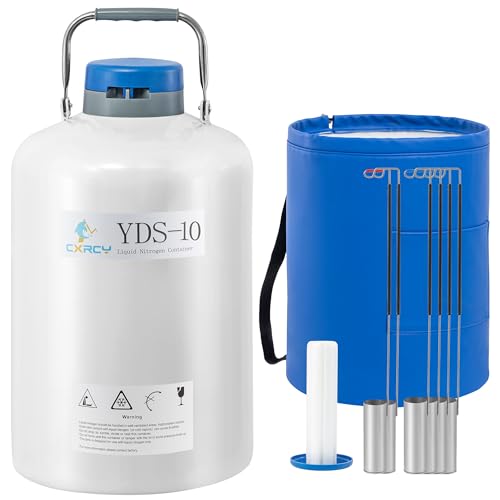
The CXRCY 10L aluminum dewar emphasizes a robust insulating design with vacuum layers and low-thermal-conductivity neck components to slow LN2 volatilization. The unit includes six canisters and a carry bag, enabling versatile storage and quick access to samples. Its dual-use capability makes it adaptable for research, beauty studios, agricultural tech, and cryogenic storage across multiple environments.
Buying Guide
- Capacity needs: Choose between 3–10 L for small-scale storage or 20 L and above for higher throughput. Larger dewars reduce frequent refilling but increase weight and handling considerations.
- Evaporation rate: Dewars with slower evaporation minimize LN2 losses, especially in busy facilities. Look for insulation quality, vacuum design, and canister configuration to influence evaporation.
- Canister system: Six canisters offer flexibility for storing multiple samples or materials. Consider whether you need holes for insertion points or closed canisters for precise LN2 extraction.
- Portability vs. stability: Lighter dewars improve transportability but may compromise stability. If moved often, ensure straps, carry bags, or wheels are included or easily added.
- Safety features: Look for robust venting, secure lids, and clear labeling. Proper training and handling protocols are essential for any LN2 operation.
- Material and build: Aluminum alloys balance weight and durability. aerospace-grade materials generally offer higher strength and longer service life in demanding environments.
- Maintenance and warranty: A longer warranty indicates confidence in durability. Check for manufacturer guidelines on cleaning, refilling, and inspection intervals.
- Intended setting: Clinical and lab environments may require models with higher reliability and faster transfer options, while beauty clinics and educational labs may prioritize compact designs and ease of use.
- Cost vs. value: While premium models may cost more, assess total ownership costs, including LN2 loss rates, replacement parts, and service availability.
Notes on usage: All models above are designed to store and transfer liquid nitrogen safely. When selecting, consider daily workflow, storage duration, required transfer speed, and the number of samples or tools to manage. For facilities handling cryogenic materials routinely, balancing capacity, portability, and evaporation control is essential to optimize operations and maintain safety standards.