Choosing the right liquid nitrogen container depends on capacity, portability, insulation, and how quickly samples can be accessed. This guide highlights five top options that balance durability, lightweight design, and reliable evaporation control for professional labs, beauty clinics, farms, and research settings. Each product is evaluated on core features such as material quality, vacuum insulation, and canister configurations to help you compare value and performance at a glance.
| Product | Brand | Capacity | Key Feature |
|---|---|---|---|
| U.S. Solid 10L Cryogenic Container | U.S. Solid | 10 L | Slower evaporation rate |
| VEVOR 10 L Liquid Nitrogen Tank | VEVOR | 10 L | Vacuum insulation with 6 canisters |
| Magula 10L Liquid Nitrogen Dewar | Magula | 10 L | Aerospace aluminum, 6 canisters |
| CXRCY 10L Cryogenic Container | CXRCY | 10 L | Vacuum insulation and dual-use design |
| U.S. Solid 6L Cryogenic Container | U.S. Solid | 6 L | Compact 6 L option with 6 canisters |
U.S. Solid 10L Cryogenic Container

Capacity reaches 10 liters, designed to hold liquid nitrogen with a slower evaporation rate. The dewar shape and material optimize storage and minimize heat transfer. Evaporation rate testing is used to verify performance, providing a basis for expected storage times in real-world use.
VEVOR 10 L Liquid Nitrogen Tank

Constructed from lightweight aviation-grade aluminum alloy for portability and durability. It uses vacuum insulation with multi-layer protection and gas adsorbents to minimize heat transfer. The 6 included canisters enable quick access to stored samples, with some canisters designed for hole-free extraction and others with openings for sample storage.
Magula 10L Liquid Nitrogen Dewar

10-liter capacity with aerospace-grade aluminum alloy construction for durability and reduced evaporation. The design emphasizes a balanced diameter to minimize leakage while maintaining a slow evaporation rate. Includes six canisters and is suitable for wide applications across laboratories, farms, and clinics.
CXRCY 10L Cryogenic Container
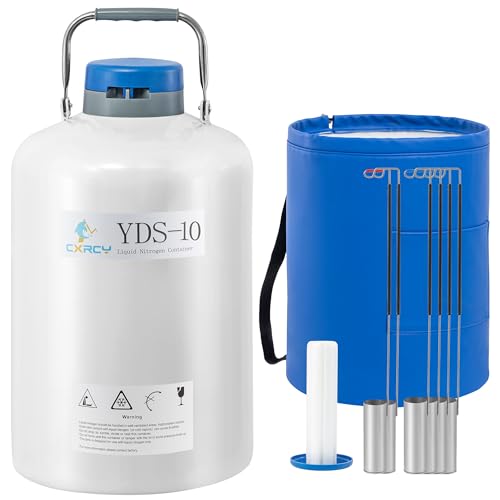
Dual-use design supports transportation and storage of liquid nitrogen, semen, embryos, and other samples. Features vacuum insulation and a good sealing neck, designed to slow evaporation and maintain low temperatures for extended periods. Suitable for scientific and industrial environments requiring reliable sample preservation.
U.S. Solid 6L Cryogenic Container

Compact 6-liter capacity with six canisters. Designed to hold liquid nitrogen for semen storage and other applications where a smaller container is advantageous. The unit emphasizes a controlled evaporation rate and sturdy construction for reliable field or lab use.
Buying Guide
When selecting a liquid nitrogen container, consider capacity needs, portability, and how quickly you need access to samples. Key factors include:
- Capacity and size: Choose a container that matches your typical volume and space constraints. Larger tanks store more LN2 but are heavier and less portable.
- Insulation quality: Vacuum insulation with multiple layers minimizes heat transfer and evaporation. Look for containers with robust seals and low thermal conductivity necks.
- Canister configuration: Containers with multiple canisters (and some without holes) allow both secure storage and easy sample retrieval. Ensure the layout fits your workflow.
- Material durability: Aluminum alloy constructions offer a good balance of strength and weight. For certain environments, aerospace-grade materials can provide added toughness and corrosion resistance.
- EVAPORATION rate testing: Some brands report evaporation measurements to help predict storage times. This can be a useful performance benchmark.
- Portability features: Handles, straps, and carry bags improve transport between locations, clinics, or field sites.
- Maintenance and safety: Check for compatibility with your handling equipment and ensure vacuum integrity and leak prevention are straightforward to inspect.
Price, warranty, and after-sales support are also important considerations, especially for institutions requiring ongoing LN2 storage. Compare not just upfront cost but total cost of ownership, including potential refills, replacement parts, and service options.