Choosing a reliable confined space gas monitor is essential for worker safety in tanks, sewers, vessels, and similar environments. The following five models balance rapid response, multi-gas detection, durability, and ease of data handling. Each product section below highlights key features and the scenarios where it excels, helping you compare capabilities at a glance.
| Product | Notable Features | |
|---|---|---|
| TopTes Guard-863Pro | H2S, CO, LEL, O2 | 5-year O2 sensor, TFT color display, USB data export |
| TopTes Guard-101 | H2S, CO, LEL, O2 | Triple alarm, 14h battery, rugged build |
| Forsensal Gas Detector with Pump | CO, O2, H2S, LEL | Built-in pump, 3000 mAh, calibration kit |
| ACEGMET MG10 | H2S, O2, CO, LEL | Type-C charging, 14h runtime, multi-alarms |
| XLA Alert Portable Gas Detector | O2, CO, H2S, EX | Factory calibrated, calibration options, rugged |
These units are designed for confined-space work where quick gas readings and reliable alarms can prevent exposure risks. The list includes models with long battery life, clear displays, and robust alarm systems. The table above provides a quick snapshot to compare core capabilities at a glance.
TopTes Guard-863Pro 4-Gas Monitor

The Guard-863Pro detects four critical gases—H2S, CO, LEL, and O2—with a fast 0.5-second response time. It uses a triple alarm system—sound, visual indicators, and vibration—to ensure immediate alerts, and it continues until readings return to safe levels. The upgraded O2 sensor, sourced from DDS (UK), extends service life to up to five years, reducing maintenance interruptions in demanding environments. A vivid TFT color display presents real-time data, including concentration matrices and trend curves, while the USB data export function streamlines record-keeping for compliance and investigations.
Best used in industrial shuttered spaces, storage tanks, and areas with potential for rapid gas shifts, this monitor suits teams that need accurate, durable protection with data traceability. The long sensor lifespan helps minimize downtime in remote worksites, and the dual capabilities of real-time visualization and exportable records support both field operations and later analysis.
TopTes Guard-101 Gas Detector
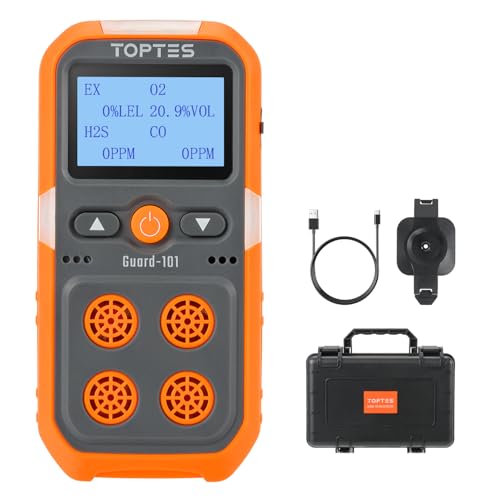
The Guard-101 focuses on four gases—H2S, CO, LEL, and O2—with rapid detection and a long 14-hour battery life. Built from high-strength ABS engineering plastic, it is waterproof, dustproof, and explosion-proof, with a back-clip that facilitates transport in the field. A password safeguard (default “69”) minimizes accidental operation, and a triple alarm system—LED, vibration, and audible alerts—remains active until concentrations normalize. It also includes an alarm-record storage function, allowing retrospective review of monitoring data for safety audits or incident investigations.
This model is well-suited for work sites requiring rugged hardware and reliable alerts in confined spaces. The combination of robust protection, lasting battery, and data storage makes it useful for routine inspections, temporary worksites, and home-based projects where consistent gas monitoring is important.
Forsensal Gas Detector With Pump

This four-gas monitor covers CO, O2, H2S, and LEL with a built-in pump, offering enhanced sampling in hard-to-reach spaces. It includes a 3000 mAh rechargeable battery and a calibration kit, with a large, legible display and a user-friendly menu for channel, alarm, and time settings. The device ships with a calibration cap, hose, and USB-C charger, and it can switch from pump suction to natural diffusion via simple assembly steps. A dramatic advantage is the ability to pull air samples actively, which can improve detection in stagnant environments common in confined spaces.
Ideal for professional use in sewer systems, vessels, and tanks where active sampling is advantageous, this model emphasizes calibration transparency and field-ready accessories. It helps ensure timely alarms and allows operators to review historical data and gas curves to interpret changing conditions over the work shift.
ACEGMET MG10 4-Gas Detector
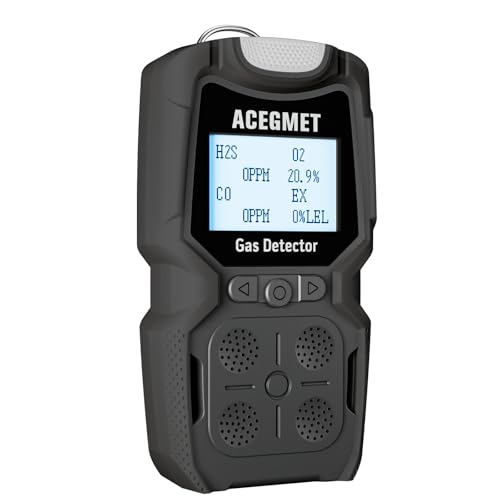
The ACEGMET MG10 provides simultaneous detection of H2S, O2, CO, and LEL with fast response and a robust alarm system. It emphasizes a durable build for work, home, and industrial settings and uses a rechargeable design for extended field use. The device features vibration, visual, and audible alerts to ensure warnings are noticed in noisy environments, and it supports a broad safety context by enabling reliable readings in confined spaces like tanks and tunnels. The manufacturer highlights a calibration workflow intended to maintain accuracy over time, including Recommend zero-adjust procedures to maintain sensor baseline integrity.
With its compact form and multi-alarm capabilities, MG10 suits teams performing routine in-situ checks, maintenance tasks, and short- to mid-duration deployments where dependable gas readings are critical for safe entry and exit decisions.
XLA Alert Portable Gas Detector

The XLA Alert multi-gas detector covers O2, CO, H2S, and explosive gas (EX). It is factory calibrated and offers calibrations via zero or span methods, supported by professional guidance from engineers. The device uses ABS engineering plastics for durability and adheres to a rugged, waterproof, and explosion-proof standard, aiming to perform reliably in harsh environments. With a focus on accuracy (±5% F.S.) and rapid response (under 30 seconds), it is positioned for field technicians who require dependable, ready-to-use equipment with straightforward maintenance.
In confined-space operations, XLA Alert is a practical choice for teams that prioritize ready-to-use readiness and clear calibration pathways. The model’s balance of portability, calibration options, and broader gas coverage makes it suitable for inspection work, maintenance campaigns, and emergency response drills where multiple gases must be tracked quickly.
Buying Guide: Key Purchase Considerations
Gas Coverage and Target Environments
Match the detector to the gases most likely to be encountered in your spaces (CO, H2S, O2, LEL, and EX). Some models emphasize fast response and multiple alarms, while others add pumping capabilities for stagnant air. Choose based on typical confined-space scenarios: tanks, tanks with ventilation, manways, sewers, and vessels.
Detection Technology and Response Time
Electrochemical sensors provide reliable, fast readings for target gases. A response time of 0.5 seconds to a few seconds is common and important for early warning. Longer-term stability and an accurate display of readings help with decision-making during entries and exits.
Alarms and Alarms Management
Consider devices with multi-modal alarms (sound, light, vibration) and continuous alarm until safe levels are restored. Some models also store alarm histories, essential for audits and incident investigations. Password protection and rugged housings reduce the risk of misuse in busy work sites.
Power, Battery Life, and Portability
Battery life ranges from roughly 8 to 14+ hours, with some models offering swap-out or pump-assisted sampling for specific environments. If you operate shifts or extended entries, prioritize longer runtimes or devices with easy recharging and spare batteries.
Data Handling and Calibration
USB data export, log storage, and NIST traceable calibration can simplify compliance reporting. Some units offer pump-assisted sampling to improve measurements in still air, while others rely on diffusion for simplicity. Look for clear calibration procedures and available accessories to support ongoing accuracy.
Durability and Certification
Rugged housings, waterproofing, dust resistance, and explosion-proof ratings are valuable in harsh industrial spaces. International safety certifications and OEM sensor quality influence long-term reliability and maintenance costs.
Summary and Selection Tips
For confined-space work, a balanced choice includes a four-gas detector, battery longevity, a clear display, and robust alarms. If active sampling is needed, a pump-equipped model is advantageous. If data handling and traceability are priorities, pick devices with USB export, alarm logs, and calibrated sensors. Consider keeping two units per crew for redundancy and cross-checking readings in large or multiple-entry tasks.