Choosing the right commercial pressure washing equipment can accelerate big cleanup tasks while delivering consistent results. This guide highlights five highly capable options across electric and gas models, plus a professional surface cleaner accessory to expand your toolkit. Each section includes key features and practical use cases to help you compare at a glance.
| Product | Brand | Key PSI / GPM | Type |
|---|---|---|---|
| Westinghouse WPX4400 | Westinghouse | 4400 PSI / 4.2 GPM | Gas |
| IvyBess Professional 4200PSI | IvyBess | 4200 PSI / 4.0 GPM | Gas |
| Westinghouse WPX3000e | Westinghouse | 3000 PSI / 1.76 GPM | Electric |
| Westinghouse WPX3200e | Westinghouse | 3200 PSI / 1.76 GPM | Electric |
| WOJET Surface Cleaner | WOJET | Not a washer; 4500 PSI surface cleaning | Accessory |
Notes: All products are described with listed features. Images are provided for visual reference. This guide aims to present a balanced view of performance, maintenance, mobility, and compatibility with common cleaning tasks in commercial settings.
Westinghouse WPX4400 Gas Pressure Washer

The Westinghouse WPX4400 delivers 4400 PSI with up to 4.2 GPM, designed for heavy-duty outdoor cleaning. Its 50-foot abrasion-resistant hose and a 1.7-gallon gas tank support extended sessions without frequent refueling. The unit includes five quick-connect nozzles (0°, 15°, 25°, 40°, and Soap) and compatibility with common pressure washer accessories such as surface cleaners and foam cannons using M22 fittings. A 4-stroke 420cc Westinghouse engine provides reliable power, while a triplex brass head pump supports sustained performance. This model is well-suited for decks, siding, and large driveways in commercial settings.
Key considerations: Gas-powered machines offer mobility and sustained cleaning power, but require fuel management and sound considerations. Maintenance intervals for engine and pump should be observed to maximize lifespan. For frequent, consistent outdoor use, this unit provides substantial cleaning leverage, particularly on tough surfaces and large areas.
Professional IvyBess 4200PSI Gas Pressure Washer

This 4200 PSI gas-powered machine delivers 4.0 GPM via a 212cc engine with an efficient axial cam pump. It includes 5 quick-connect nozzles (0°, 15°, 25°, 40°, and Soap) and a 33-foot hose, making it capable of deep cleaning concrete, siding, fences, and vehicles. The unit emphasizes portability with 10-inch wheels and a recoil-start system for quick startup. EPA/CARB/ETL compliance adds a layer of regulatory assurance for professional use.
Key considerations: Gas engines provide strong cleaning power and portability but require fuel handling and regular maintenance. This model is effective for frequent, large-area projects, especially where electrical outlets are impractical. Consider noise, startup needs, and storage space when integrating into a professional fleet.
Westinghouse WPX3000e Electric Pressure Washer
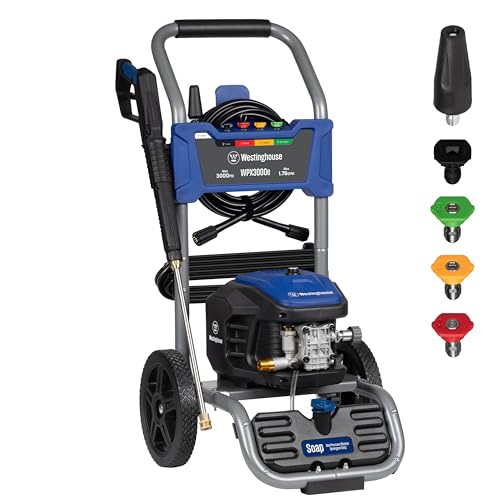
The WPX3000e provides 3000 max PSI with up to 1.76 GPM, suitable for smaller commercial workloads and frequent setups. It includes a 0°, 15°, 25°, and turbo nozzle plus a soap nozzle within a 5-nozzle set. An onboard soap tank helps with detergent application, while the corrosion-resistant pump supports reliable performance over time. A 25-foot hose keeps the unit reasonably mobile for sidewalk and patio cleaning, vehicle washing, and exterior wall maintenance on mid-sized properties.
Key considerations: Electric machines generally offer quieter operation and simpler maintenance but require a reliable power source. For fleets that prioritize low noise and refill simplicity, electric models like this WPX3000e are advantageous for routine maintenance tasks around homes and small commercial sites.
Westinghouse WPX3200e Electric Pressure Washer
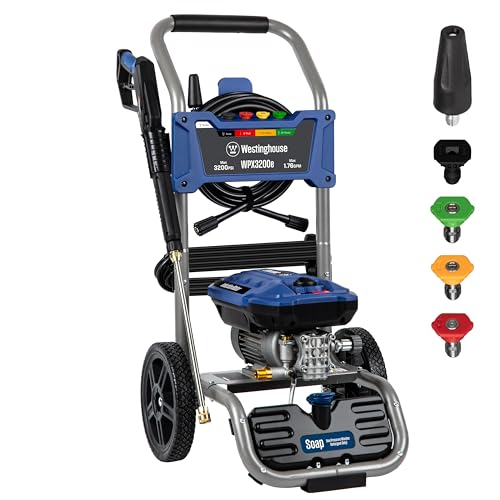
The WPX3200e raises efficiency with 3200 max PSI and 1.76 GPM, while maintaining a compact electric footprint. It features a built-in .61 gallon soap tank and the same 25-foot abrasion-resistant hose with a five-nozzle set, including 0°, 15°, 25°, turbo, and soap. The induction motor adds durability, and the axial cam pump supports long-lasting performance. This model targets mid-size cleaning tasks on decks, fences, driveways, and vehicles, with straightforward plug-and-clean operation.
Key considerations: For facilities with regulated electrical access, this model offers steady performance with predictable maintenance. Its onboard soap tank reduces accessory clutter and improves workflow during routine surface cleaning and vehicle maintenance projects.
WOJET 20″ Surface Cleaner With Wheels

WOJET’s surface cleaner attachment is designed to pair with pressure washers to reduce stripe marks and speed up cleaning on large flat surfaces. The 20-inch head uses two high-pressure jets for even cleaning and improved efficiency on driveways, sidewalks, decks, and patios. Four wheels and dual handles make it more maneuverable than traditional flat heads, while a sealed, pre-greased swivel minimizes debris intrusion and prolongs life in busy work environments. This accessory is ideal for commercial crews needing fast, uniform results on expansive areas.
Key considerations: A surface cleaner doesn’t create pressure by itself; it piggybacks on your existing washer. Ensure your chosen machine can deliver compatible PSI and flow to optimize the attachment’s performance. The design prioritizes speed and evenness, reducing operator fatigue on large jobs.
Buying Guide: Key Purchase Considerations
- Power source and mobility: Electric machines are quieter and simpler to maintain, ideal for trades expecting frequent indoor or urban cleaning. Gas units deliver maximum cleaning power and portability for large outdoor areas but require fuel, maintenance, and ventilation planning.
- PSI and GPM balance: Higher PSI and GPM enable deeper cleaning on tough surfaces, but requirements vary by project—wood decks, concrete, siding, and vehicles each benefit from different combinations. Consider job size and surface type when selecting.
- Durability and pump design: Triplex brass head pumps offer robustness for frequent use, while induction motors provide longevity in electric models. Look for corrosion-resistant components and service accessibility in maintenance plans.
- Nozzle options and accessories: A five-nozzle set (including 0°, 15°, 25°, and soap) covers most tasks. Soap integration, foam cannons, surface cleaners, and undercarriage or foam accessories expand capability for commercial crews.
- Portability and storage: Weight, wheel size, hose length, and compact form factor influence efficiency on job sites. Long hoses improve reach, while manageable weights reduce operator fatigue during repeated passes.
- Regulatory and safety considerations: Gas units require safe fueling, exhaust management, and adherence to local emission standards. Electric units should meet safety specifications for electrical outlets, cords, and GFCI use where applicable.
- Cost of ownership: Consider initial price, maintenance intervals, replacement parts (filters, pumps, seals), and potential downtime for service. A balance between upfront cost and long-term reliability drives total cost of ownership.
- Intended use and scalability: If you manage multiple sites or larger contracts, selecting a slightly higher-capacity machine or modular accessories can yield better long-term value than a basic unit.
This selection emphasizes versatile cleaning power, reliable performance, and practical add-ons for professional or commercial use. Each product offers a distinct balance of power, portability, and maintenance needs to suit a range of cleaning tasks—from vehicle fleets and building exteriors to large walkways and patios.