Automated flow control valves regulate hydraulic and pneumatic systems with precision, improving efficiency, stability, and safety. This guide highlights five relevant products designed to automate flow and pressure control in water, oil, and gas environments. Readers will find practical insights on selecting valves that balance range, durability, and ease of installation for American-based applications.
Product Summary
| Product | Brand | Key Features | Typical Use |
|---|---|---|---|
| Grinsvalley 2 Pcs Hydraulic Flow Control Valve KC-04 | Grinsvalley | Two valves, up to 3000 PSI, 30 LPM, carbon steel | Hydraulic systems requiring precise throttling |
| Summit Hydraulics Hydraulic Adjustable Variable Flow Control Valve w/Relief | Summit Hydraulics | 0-30 GPM, relief valve, adjustable | Variable flow control with overpressure protection |
| LOSTAR 1/2″ NPT Straight Flow Control Needle Valve | LOSTAR | 0-5000 PSI, adjustable knob, dustproof lids | High-precision flow in hydraulic lines |
| Flow Control Valve 1/2″ Throttle Check Valve NPT 3000PSI | YACO VALVE | Needle/Throttle style, carbon steel | Flow regulation with check valve capability |
| Flow Control Throttle Check Valve 3/8″ NPT 3000PSI | YACO VALVE | Throttle/check combination, carbon steel | Compact flow control in hydraulic lines |
Grinsvalley Hydraulic Flow Control Valve KC-04

Grade: carbon steel construction supports high-pressure operation up to 3000 PSI, with a flow capacity of 30 LPM. This package includes two 1/2 inch NPT valves, suitable for water, oil, and gas systems. The KC series emphasizes precise throttling to regulate flow and pressure, enhancing system stability across demanding applications.
Summit Hydraulics Adjustable Variable Flow Control Valve

This pressure-compensating valve includes an internal relief, enabling safe operation with adjustable flow from 0 to 30 GPM. It is designed to maintain consistent output despite varying system pressures, reducing surge and maintaining performance across hydraulic circuits. Its relief valve helps protect components and maintain system reliability.
LOSTAR 1/2″ NPT Straight Flow Control Needle Valve

Built for robust duty, this 1/2″ NPT valve supports up to 5000 PSI. An adjustable rotatable knob enables precise setting of flow, while a dustproof design guards imports of contaminants. It is suitable for systems requiring careful throttling and velocity control in hydraulic lines.
YACO VALVE Flow Control Valve 1/2″ NPT

Precisely engineered as a hydraulic flow control/needle valve in carbon steel, this unit focuses on throttle capability with reliable sealing. Its 1/2″ NPT configuration suits mid-size hydraulic lines and pressure systems, balancing precise control with rugged construction.
YACO VALVE Flow Control Throttle Check Valve 3/8″ NPT
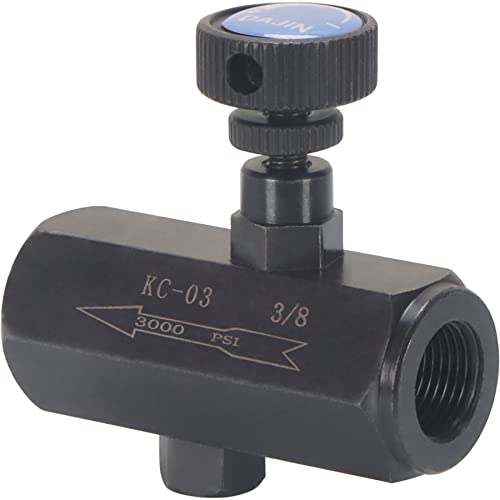
This 3/8″ NPT valve combines throttle and check functions for compact flow control. Carbon steel build supports robust use in hydraulic lines, making it suitable where space is limited and control accuracy is essential.
Buying Guide
Key considerations
- Pressure rating: Choose valves compatible with your system’s maximum PSI to avoid leakage or failure.
- Flow range and control type: Determine whether you need throttling, needle-style adjustment, or relief-capable control for steady performance.
- Materials and environment: Carbon steel offers strength for harsh environments, but consider corrosion resistance for certain fluids.
- Installation and fittings: Verify NPT size (often 1/2″ or 3/8″) and whether push-to-connect or threaded fittings suit your setup.
- Maintenance and sealing: Look for robust seals and protective features (dust caps, easy adjustment) to minimize downtime.
- Size and footprint: Ensure the valve fits in the available space without restricting adjacent components.
- Cost of ownership: Consider longevity, maintenance frequency, and potential replacement parts when evaluating total cost.
Performance perspectives
- Precision-focused valves deliver repeatable flow control essential for process consistency and safety.
- Relief-capable models protect components by venting excess pressure, reducing system risk.
- Compact throttle-check options offer space-saving solutions for tight installations.
Installation tips
- Align flow direction with valve markings to ensure correct operation.
- Use proper wrenches to avoid overtightening and damaging fittings.
- Inspect seals and connectors during installation to prevent leaks.
- Test the system with gradual pressure increases to verify performance.