For engineers, designers, and hobbyists pursuing precise reverse engineering, choosing the right 3D scanner is essential. This guide highlights top handheld and portable scanners with metrology-grade accuracy, fast capture, and color texture options to help you capture mechanical parts, automotive components, and complex artifacts with fidelity. Each pick is evaluated for accuracy, speed, surface handling, and workflow compatibility to support reliable reverse engineering across different materials and object sizes.
| Product | Brand | Key Strength | Best For |
|---|---|---|---|
| Revopoint MetroX 3D Scanner | Revopoint | 0.01 mm precision, 60 fps, dark surface handling | Industrial measurement, high-accuracy parts |
| Revopoint MIRACO Plus | Revopoint | 0.02 mm precision, full-color, photogrammetry | Small to large objects, color fidelity |
| Creality Raptor Pro | Creality | 0.02 mm metrology-grade, 660k pts/s, dual blue laser | Industrial inspection, reverse engineering |
| Creality Otter Lite Basic | Creality | 0.05 mm resolution, RGB+IR color, plug-and-play | Portable scanning, DIY projects |
| Revopoint POP3 Plus | Revopoint | 0.04 mm precision, 18 fps, full-color | Medium objects, color scans |
Revopoint MetroX 3D Scanner

MetroX is designed for metrology-grade scanning with an industrial-grade blue laser system. It delivers accuracy up to 0.02 mm and a fused point cloud distance of 0.05 mm. The system supports multiple scanning modes, including Full-field and Auto Turntable, to optimize measurement of curved or complex surfaces. Its GPU-accelerated blue laser lines enable efficient scanning of dark or shiny materials, up to 60 frames per second. MetroX is suitable for detailed mechanical parts, molds, and precision components where high fidelity is required. Users should note laser safety guidance and device-to-object distance for best results.
Revopoint MIRACO Plus

The MIRACO Plus combines photogrammetric metrology with a quad-depth camera system and 48MP RGB color capture. It offers 0.02 mm single-point cloud accuracy and versatility across small to large objects. The kit includes high-precision calibration tools and coded targets to support accurate measurements on a variety of parts. With safe infrared laser technology and enhanced optics, MIRACO Plus provides high-detail color scans with less noise, making it well-suited for precise reverse-engineering workflows where color detail matters.
Creality Raptor Pro 3D Scanner

Raptor Pro combines metrology-grade accuracy with a dual blue laser approach for dense and fast scans. It features 22 cross laser lines for medium-to-large objects and 7 laser lines for detailed partial scans, with a 0.02 mm accuracy target. The inclusion of NIR structured light supports marker-free scanning of feature-rich parts, while a dedicated face/body mode enhances scanning versatility for human-involved projects. It is a solid option for engineering teams performing rapid reverse-engineering and inspection tasks.
Creality Cr3D Raptor X 3D Scanner

The Raptor X blends 34 cross blue laser lines with NIR structured light, offering 0.02 mm single-frame accuracy and up to 0.02 mm + 0.06 mm/m volume accuracy. Its portable Wi-Fi 6 capability provides fast wireless data transfer, making it ideal for on-site reverse engineering and large-object scanning. The combination of blue laser and infrared structured light supports efficient coverage of complex shapes, edges, and curves while delivering reliable color capture for texture-rich models.
Creality Otter Lite Basic 3D Scanner

Otter Lite Basic emphasizes portability with a compact design and color texture mapping. It supports 0.05 mm resolution and dual-mode scanning (close-range and long-range), enabling detailed scans of smaller items as well as larger assemblies. RGB and infrared cameras provide true-color textures at up to 30 fps, with output formats suitable for 3D printing, VR, and reverse engineering. Its lightweight form factor makes it a practical option for fieldwork and quick iterative scans.
Revopoint POP3 Plus
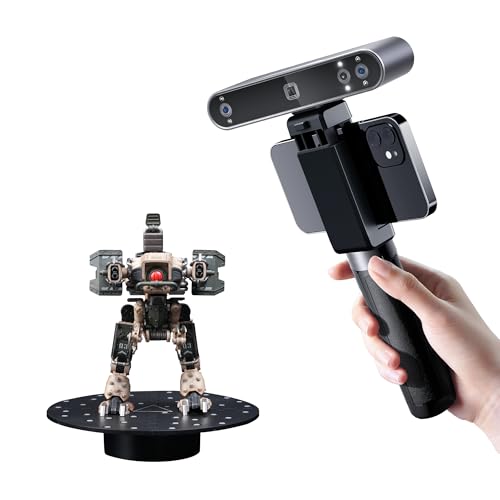
POP3 Plus focuses on refined precision with improved calibration and optical zoom, delivering around 0.04 mm accuracy. It provides fast scanning speeds up to 18 fps and an IMU for scan stabilization, along with full-color texture capture through an HD RGB camera. This model suits medium-sized objects and workflows that require stable, color-accurate scans for reverse engineering and digital archiving of color-rich parts.
Revopoint MIRACO Pro

The MIRACO Pro offers wireless operation with onboard processing for scanning and editing. It claims up to 0.02 mm single-frame precision and strong color capture using a 48 MP RGB camera and flash LEDs. Its quad-depth camera system enables versatile object scanning from tiny components to large machinery, with Near-mode and Far-mode options for flexible detail capture. This model is suitable for consumable or production environments where wireless convenience and color texture are priorities.
Buying Guide: Key Considerations for Reverse-Engineering Scanners
When evaluating 3D scanners for reverse engineering, consider accuracy, speed, surface handling, and workflow compatibility. Higher precision (0.02 mm to 0.04 mm range) is essential for dimensional validation and CAD model creation, but it may come at the cost of scan speed or larger object reach. Surface finish matters: dark, shiny, or reflective surfaces benefit from blue laser or structured light with GPU acceleration to reduce the need for spray or coating. Color texture can be important for feature recognition, documentation, and assembly simulations, though it may slightly impact scan time.
Object size and geometry influence the choice between handheld, portable, and desktop scanners. For intricate mechanical parts or molds, devices with multiple laser lines and advanced metrology modes (full-field, auto turntable) help maintain coverage and reduce post-processing. Wireless or Wi-Fi transfer capabilities speed up fieldwork and on-site measurements, but ensure compatibility with your preferred software workflow (CAD/CAM, mesh editing, and metrology suites).
System compatibility is another factor: check operating system support (Windows, macOS), USB or network connectivity, and whether the scanner’s software includes calibration procedures, targets, or turntables. Finally, evaluate total cost of ownership, including accessories, replacement parts, and ongoing software updates, to ensure long-term value in a reverse-engineering or quality-control context.